
In investment casting, wax quality directly affects pattern consistency, assembly accuracy, and final casting performance. When wax is overheated, unevenly mixed, or transferred at inconsistent temperatures, it can lead to avoidable process variation.
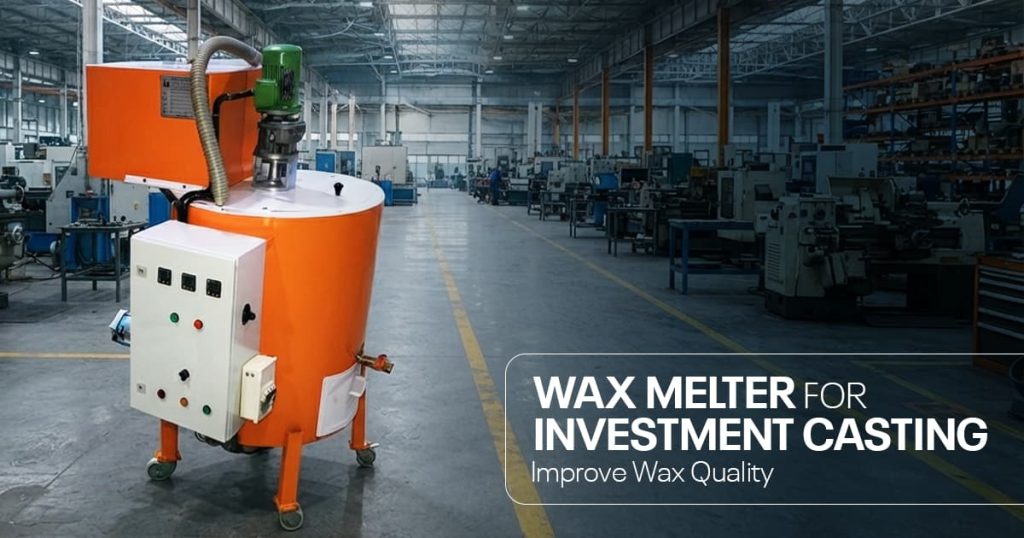
A modern wax melting and conditioning system helps foundries maintain better control from wax preparation to pattern production. Laxminarayan Technologies Wax Melter combines controlled melting, continuous stirring, temperature conditioning, and optional wax transfer in one practical system designed for investment casting applications.
Why Controlled Wax Conditioning Matters
Wax slabs and pellets need to be converted into a consistent, usable medium before they are supplied to downstream equipment. Simply melting wax in an open container may create temperature fluctuations, inconsistent viscosity, and unnecessary handling.
A dedicated wax conditioning system offers a more controlled approach by:
-
Melting wax at a controlled rate
-
Maintaining a uniform temperature
-
Continuously stirring the wax
-
Reducing manual handling
-
Supporting consistent transfer to wax injection equipment
-
Improving process repeatability across production batches
This is especially useful for foundries producing a wide range of wax patterns or operating multiple injection machines.
How the Laxminarayan Technologies Wax Melter Works
The system uses an aluminium drip melting attachment positioned above the Aluminium conditioning tank. Aluminium enables quick and uniform heating. Wax slabs or granules are placed in the drip melter, where they melt and flow into the conditioning tank below.
Inside the tank, the wax is continuously stirred while being maintained at a preferred temperature. This helps create a more uniform blend before the wax is transferred for further processing.
The available melting rates include:
-
10 kg per hour
-
15 kg per hour
The conditioning tank is available in standard capacities of:
-
100 kg
-
150 kg
-
200 kg
-
250 kg
Custom tank sizes can also be considered based on production requirements.
Integrated Wax Transfer for Better Workflow
The Wax Melter can be supplied with a temperature-controlled positive-displacement wax transfer pump. The pump has a maximum flow rate of up to 10 litres per minute, while the heated hose helps maintain wax temperature during transfer.
This configuration can reduce the need for repeated manual movement of molten wax between equipment. It also supports a cleaner connection between wax conditioning and injection operations.
For facilities using automated or semi-automated production methods, controlled transfer can help create a more organised and repeatable workflow.
Choosing the Right Configuration
The equipment can be ordered with or without selected options, including:
-
Drip or slab melting attachment
-
Wax transfer pump
-
Heated hose
-
Mobility wheels
-
Conditioning tank in the required capacity
The right configuration depends on factors such as daily wax consumption, batch size, available floor space, transfer distance, and the type of wax injection process being used.
For smaller operations, a compact configuration may be sufficient. Larger foundries may benefit from a higher-capacity conditioning tank with an integrated pump and mobile arrangement.
Machines That Pair Well with a Wax Melter
A wax melter is not an isolated piece of equipment. It becomes more valuable when it is integrated into the wider investment casting workflow.
1. Wax Injection Machine
Conditioned wax can be supplied to a Wax Injection Machine for producing consistent wax patterns. Laxminarayan Technologies offers wax injectors with features such as multi-zone temperature control, metered injection, hydraulic pattern ejection, water-cooled platens, and optional double shuttle tables.
This combination is particularly useful for foundries that want better control over both wax preparation and pattern injection.
2. Wax Sprue Extruder
A Wax Sprue Extruder is useful when the foundry produces wax bars, runner sections, or tubular profiles in different cross-sectional sizes.
The extruder can process filled and unfilled waxes, with optional tooling for specific shapes. Pairing it with a controlled wax melting and conditioning setup can help support more consistent material preparation across the production line.
3. Wax Sprue Maker
For producing pouring cups, runner bars, and down sprues, a Wax Sprue Maker can be added to the workflow.
The machine uses water-cooled aluminium dies and can produce up to 60 sprues per hour, depending on the configuration. It is a practical choice for foundries that want to standardise the sprue-making stage and reduce manual wax casting work.
Key Benefits of a Wax Melting and Conditioning System
A properly configured wax melter can support several operational improvements:
Consistent Wax Temperature
Temperature control helps maintain wax in a suitable condition for transfer and use, reducing the risk of inconsistent flow or overheating.
Uniform Wax Blend
Continuous stirring helps maintain a more uniform blend in the conditioning tank, which is important for repeatable pattern production.
Reduced Manual Handling
The optional pump and heated hose can reduce the need to manually carry or transfer molten wax.
Flexible Capacity
Multiple standard tank sizes allow foundries to select a configuration that matches their production volume.
Easier Equipment Integration
The system can be used as part of a wider investment casting setup that includes wax injection, sprue production, pattern assembly, shell building, and dewaxing equipment.
What to Consider Before Buying
Before selecting a wax melter, review the following requirements:
-
Required tank capacity: Estimate the amount of wax used per shift or production batch.
-
Melting rate: Choose between the available 10 kg/hr and 15 kg/hr options based on production demand.
-
Wax type: Confirm whether the system will process slabs, pellets, filled wax, or other materials.
-
Transfer distance: A heated hose and pump may be useful when wax must be transferred directly to another machine.
-
Mobility: Wheels can be considered when the equipment needs to be repositioned on the shop floor.
-
Future expansion: Select a configuration that can support expected increases in production.
A Practical Upgrade for Modern Investment Casting Lines
Modern foundries are focusing on repeatability, process visibility, operator safety, and efficient use of materials. A wax melting and conditioning system addresses these needs at one of the earliest stages of the investment casting process.
By controlling how wax is melted, mixed, conditioned, and transferred, foundries can build a more stable foundation for downstream operations. When combined with a wax injection machine, sprue-making equipment, assembly tables, and advanced dewaxing systems, the Wax Melter can become an important part of a connected production workflow.
Explore the complete IC Machines range of investment casting machinery or contact the team to discuss the right wax melting and conditioning configuration for your foundry.
Frequently Asked Questions
Question: What is a wax melter used for?
Ans: A wax melter is used to melt wax slabs or granules and maintain the melted wax at a controlled temperature for further processing or transfer.
Question: What tank capacities are available?
Ans: Standard conditioning tank capacities include 100 kg, 150 kg, 200 kg, and 250 kg. Custom sizes may also be available.
Question: Is a heated wax transfer pump included?
Ans: The wax transfer pump is an optional configuration. The equipment can be ordered with or without the pump, depending on the application.
Question: What is the purpose of the heated hose?
Ans: The heated hose helps maintain wax temperature during transfer from the conditioning tank to another machine or process stage.
Question: Can the Wax Melter be used with a wax injection machine?
Ans: Yes. The conditioned wax can be transferred to a wax injection machine as part of an integrated investment casting workflow.