
In investment casting, the ceramic shell must be strong, uniform, and stable enough to withstand dewaxing, firing, and molten metal pouring. One of the most important steps in shell building is stucco application, where refractory sand is deposited over the wet slurry-coated wax cluster.
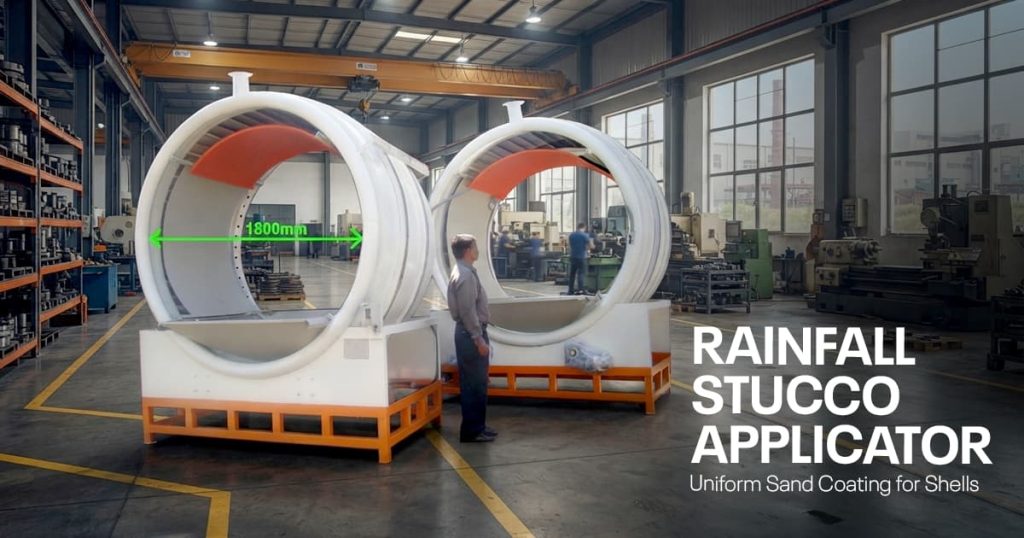
A modern Rainfall-Type Stucco Applicator helps foundries apply refractory particles more evenly while reducing spillage, manual effort, and process variation. The Rainfall-Type Stucco Applicator from Laxminarayan Technologies is designed for controlled, vibration-free, and efficient sand application in investment casting shellrooms.
A rainfall-type stucco applicator is a machine used to coat wet, slurry-dipped wax clusters with a controlled layer of refractory sand.
Instead of applying sand manually or allowing particles to fall unpredictably, the equipment creates a consistent “rain” of stucco over the cluster. The operator or robotic system manipulates the cluster through the falling refractory particles to achieve uniform coverage.
This process is also known as:
-
Rainfall stucco application
-
Sand raining
-
Sand rain application
-
Investment casting stuccoing
-
Refractory particle application
Why Uniform Stucco Application Matters
The shell-building process usually involves repeated cycles of slurry dipping and stuccoing. Each layer contributes to the strength, permeability, surface quality, and dimensional stability of the ceramic shell.
Uneven stucco application may result in:
-
Inconsistent shell thickness
-
Weak areas in the ceramic shell
-
Poor inter-layer bonding
-
Excessive refractory consumption
-
Sand accumulation on delicate pattern sections
-
Higher risk of shell cracking
-
Increased casting defects and rework
A controlled rainfall system supports more predictable shell construction, especially when production volume and component complexity increase.
How the Laxminarayan Technologies Stucco Applicator Works
The Rainfall-Type Stucco Applicator creates a uniform flow of refractory particles over the wet cluster. The cluster is moved or rotated through the sand rain so that the particles cover the required surfaces.
The RTS1000 design uses a rotating drum with adjustable baffles in the sand elevator system. These baffles help control the movement and delivery of refractory particles.
The system is designed for:
-
Uniform sand rain
-
Low material spillage
-
Vibration-free operation
-
Adjustable particle flow
-
Manual or robotic operation
-
Efficient refractory usage
The equipment is available in diameters of 1000 mm and 1800 mm, allowing foundries to select a suitable working area based on cluster size and production requirements.
Key Features of a Modern Rainfall Stucco Machine
Adjustable Baffle Angle
Adjustable baffles help control how refractory material moves through the elevator and reaches the application area. This allows the process to be adapted to different particle sizes and operating conditions.
Uniform Refractory Coverage
The rainfall method creates a consistent curtain of sand, helping operators achieve more even coverage over the slurry-coated cluster.
Reduced Refractory Waste
Controlled particle delivery can reduce overspill and unnecessary material loss. This is particularly valuable when working with high-cost ceramic or refractory materials.
Vibration-Free Operation
The machine is designed for smooth operation without unnecessary vibration, supporting stable sand flow and better operator control.
Manual or Robotic Integration
The cluster can be manipulated manually or by a robotic system. This makes the equipment suitable for both conventional foundries and automation-focused production lines.
Low-Maintenance Design
The machine uses a practical construction with MS powder-coated components and a simple operating concept designed for reliable use in foundry environments.
Quiet and Smooth Performance
The rotating drum and adjustable baffle system are designed for silent, smooth, and controlled operation during the stuccoing cycle.
Frequently Asked Questions
Question: What is a rainfall-type stucco applicator used for?
Ans: It is used to apply refractory sand uniformly over wet slurry-coated wax clusters during ceramic shell manufacturing for investment casting.
Question: How does a sand raining machine improve shell building?
Ans: It creates a controlled flow of refractory particles, which can improve coating consistency, reduce spillage, and support more uniform ceramic shell layers.
Question: Can the machine be used manually?
Ans: Yes. The cluster can be manipulated manually through the rainfall of refractory particles.
Question: Can it be integrated with robotics?
Ans: Yes. The equipment can be used with robotic cluster manipulation systems for more automated shell-building operations.
Question: What sizes are available?
Ans: The RTS1000 design is available in 1000 mm and 1800 mm diameter configurations.
Question: Does the machine reduce sand wastage?
Ans: Its controlled sand flow, adjustable baffles, and low-spillage operation are designed to reduce unnecessary refractory material loss.
Question: What type of material does it apply?
Ans: The machine is designed to apply refractory sand or stucco particles to wet ceramic slurry-coated clusters.
Why Foundries Are Moving Toward Automated Stuccoing
Investment casting manufacturers are upgrading shellrooms to improve consistency, reduce dependency on manual labour, and control process costs. Stucco application is a strong candidate for automation because the quality of the sand layer directly affects the final ceramic shell.
A modern stucco applicator can support:
-
More repeatable shell layers
-
Better control of refractory consumption
-
Improved operator productivity
-
Reduced manual handling
-
Cleaner shellroom operation
-
Easier integration with robotic systems
-
More consistent results across production shifts
Automation is not only about speed. The real advantage is repeatability. A stable stuccoing process makes it easier to maintain consistent shell quality across different operators and production batches.
The Role of Stuccoing in the Investment Casting Process
The stuccoing stage sits between slurry coating and ceramic shell development. A typical shell-building workflow includes:
-
Wax patterns are produced using a Wax Injection Machine.
-
Patterns are assembled into trees or clusters using an Assembly Table.
-
The cluster is dipped into ceramic slurry.
-
The wet cluster is coated with refractory sand using a rainfall-type stucco applicator.
-
The dipping and stuccoing cycles are repeated to build the required shell thickness.
-
The completed shell is dewaxed and fired.
-
Molten metal is poured into the prepared ceramic shell.
Every stage affects the next. If the stucco layer is inconsistent, later shell layers may not bond or build uniformly.
Machines That Complement a Rainfall-Type Stucco Applicator
Foundries purchasing a stucco applicator may also require supporting equipment for slurry preparation, transfer, shell handling, and final processing.
Slurry Transfer Pump
A Slurry Transfer Pump transfers prepared slurry to storage tanks or in-cell dipping tanks.
The trolley-mounted design can serve multiple areas of the shellroom and support the movement of different slurry compositions with washing between changes.
Fluidised Bed Stucco Applicator
A Fluidised Bed Stucco Applicator can be considered for applications where fluidised refractory particles are preferred for coating wet clusters.
The choice between rainfall and fluidised-bed stuccoing depends on cluster geometry, refractory material, production volume, automation requirements, and shellroom layout.
Robotic Shell Building
Robotic Shell Building can reduce manual movement and improve repeatability across dipping and stuccoing cycles.
A reliable stucco applicator is an important part of this setup because robotic movement is only effective when the refractory particle flow is stable and predictable.
Shell Firing Furnace
After dewaxing, the ceramic shells are fired in a Shell Firing Furnace. The furnace preheats the shells to the required casting temperature and supports the strength and stability needed before metal pouring.
Inert Gas Flash Dewax System
The Inert Gas Flash Dewax System combines dewaxing, wax recovery, and burnout in a single process.
For foundries working toward lower labour requirements, improved wax recovery, and a more integrated process flow, this equipment may be considered as part of a broader shellroom upgrade.
Rainfall Stuccoing vs Manual Sand Application
Manual sand application may be suitable for small-scale or low-volume operations, but it becomes difficult to control as production grows.
| Factor | Manual Sand Application | Rainfall-Type Stucco Applicator |
|---|---|---|
| Sand distribution | Operator-dependent | Controlled rainfall |
| Refractory waste | Usually higher | Reduced spillage potential |
| Process repeatability | Can vary by operator | More consistent |
| Production scalability | Limited | Better suited to higher volume |
| Automation readiness | Low | Manual or robotic operation |
| Operator effort | Higher | Lower |
| Shellroom cleanliness | More difficult to manage | Smoother, controlled operation |
The machine does not remove the need for process knowledge. Operators still need to select suitable particle sizes, control slurry condition, and use the correct cluster movement pattern. It simply gives them a more stable platform to work from.
A Global Solution for Investment Casting Foundries
Laxminarayan Technologies is based in Kolhapur, Maharashtra, India, and manufactures machinery for investment casting and lost-wax foundry applications.
Its equipment portfolio supports key production stages, including:
-
Wax melting and conditioning
-
Wax injection
-
Wax sprue production
-
Pattern assembly
-
Ceramic slurry preparation
-
Slurry transfer
-
Stucco application
-
Shell building
-
Dewaxing
-
Shell firing
-
Knockout and finishing
For foundries in India and international markets, equipment selection should consider production capacity, local utilities, refractory specifications, operator training, maintenance access, automation level, and future expansion plans.
Explore the complete IC Machines range to plan a connected investment casting production line.
How to Choose the Right Stucco Applicator
Before selecting a rainfall-type stucco applicator, evaluate:
Cluster dimensions: Confirm that the working diameter suits the largest cluster being produced.
-
Production volume: Higher output may require a larger machine or multiple application stations.
-
Refractory particle size: Check compatibility with the sand or stucco grades used in the shellroom.
-
Manual or robotic operation: Decide whether the process will remain operator-controlled or move toward automation.
-
Material cost: Controlled delivery is especially valuable when refractory materials are expensive.
-
Shellroom layout: Consider machine access, operator movement, dust control, and material loading.
-
Future upgrades: Choose a system that can support robotic shell building or additional process monitoring later.
The Future of Investment Casting Stucco Application
The next generation of shellrooms will focus on controlled material flow, repeatable recipes, automation-ready equipment, and reduced waste. Stucco application is moving away from purely manual handling toward systems that can be integrated with robotics and structured process control.
A rainfall-type stucco applicator offers a practical upgrade because it improves the consistency of a critical shell-building step without making the process unnecessarily complicated.
For foundries that want better shell quality, lower refractory waste, and improved production repeatability, controlled sand raining is a smart place to start.
Conclusion
The Rainfall-Type Stucco Applicator from Laxminarayan Technologies is designed to deliver uniform refractory sand application for investment casting shell production. With adjustable baffles, smooth operation, low spillage, vibration-free working, and manual or robotic compatibility, it supports the requirements of modern foundries.
When combined with a Secondary Slurry Mixer, Slurry Transfer Pump, robotic shell-building equipment, and a reliable shell firing system, it becomes part of a more controlled and future-ready ceramic shell production line.