
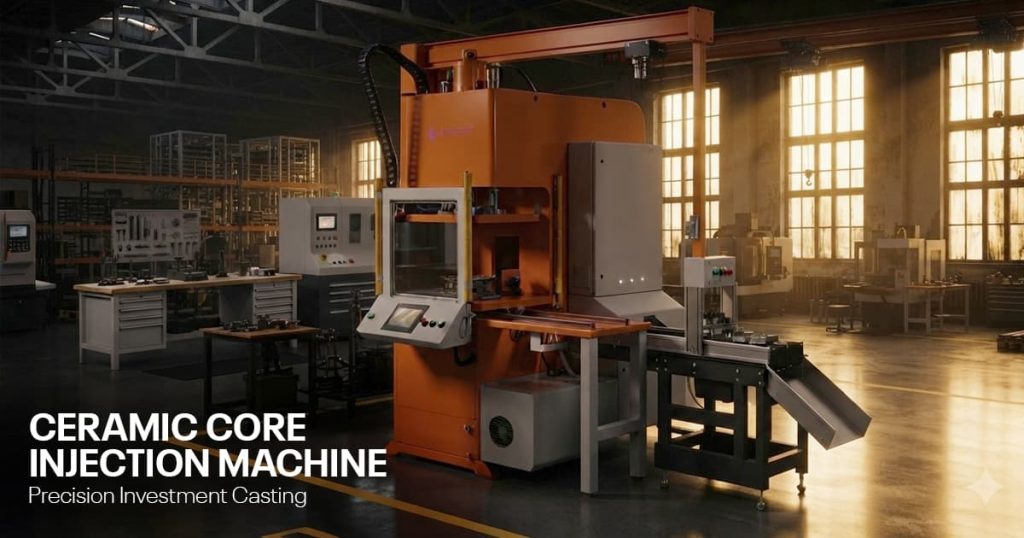
In modern investment casting, ceramic cores play a critical role in producing complex internal passages, cavities, and lightweight geometries that cannot be achieved through conventional machining. As industries such as aerospace, power generation, automotive, and precision engineering demand more complex castings, manufacturers need ceramic core production equipment that delivers accuracy, repeatability, and process control.
The Ceramic Core Injection Machine from Laxminarayan Technologies is designed for manufacturing ceramic cores used in investment casting and lost-wax foundry applications. Built with robust engineering and modern control features, the machine supports reliable ceramic injection with low operating costs and consistent production performance.
What Is a Ceramic Core Injection Machine?
A ceramic core injection machine forms ceramic cores by injecting a prepared ceramic compound into precision moulds under controlled pressure and temperature.
After moulding, the ceramic cores are processed through cleaning, debinding, and sintering before being used inside wax patterns. During casting, the core creates the required internal cavity in the final metal component.
This makes ceramic core injection especially important for components such as:
-
Turbine blades and vanes
-
Aerospace components
-
Industrial gas turbine parts
-
Automotive precision castings
-
Complex engineering components
-
Components with internal cooling passages
Why Ceramic Core Quality Matters
The performance of the final casting depends heavily on the quality of the ceramic core. Dimensional variation, air entrapment, weak sections, or inconsistent density can affect the accuracy and reliability of the finished component.
A controlled ceramic injection process helps manufacturers improve:
-
Core dimensional accuracy
-
Repeatability between production batches
-
Surface quality
-
Material distribution
-
Production efficiency
-
Compatibility with complex core geometries
For high-value castings, better core consistency can reduce rework, scrap, and downstream inspection issues.
Key Features of the Laxminarayan Ceramic Core Injection Machine
The Ceramic Injection Machine CxxTSA is available in 20T, 35T, and 50T configurations, with injection shot sizes up to 7.5 litres. Customised configurations can also be considered for specific production requirements.
Robust C-Frame Press
The machine uses a sturdy C-frame press design, with available press capacities ranging from 12 to 100 tons depending on the configuration. This provides stable die clamping and reliable operation during injection.
Multi-Zone Temperature Control
Ceramic injection materials require controlled temperature management for consistent flow and mould filling. Multi-zone temperature control helps maintain the required processing conditions across the injection system.
Motorised X-Z Nozzle Positioning
The X-Z settable side injection nozzle allows accurate positioning for different die arrangements. Motorised nozzle adjustment can help improve setup convenience and repeatability.
Hardened Ceramic Contact Parts
All ceramic contact parts are hardened for extended service life. This is particularly important in an application where abrasive ceramic materials can cause premature wear on conventional components.
Easy Seal Replacement
The machine is designed for practical maintenance, with seals that can be replaced easily when required. This can help reduce service time and improve equipment availability.
Touch Panel with Self-Diagnostics
The touch-panel interface provides a modern operating experience, while self-diagnostics help operators identify machine conditions and potential issues more efficiently.
Reliable Electro-Hydraulics
A dependable electro-hydraulic package supports stable machine operation and controlled injection performance across production cycles.
Optional Digital Hydraulics
Digital hydraulics can be added for time-based or volume-based injection control. This option is useful for manufacturers looking to improve process repeatability and standardise production settings.
Optional Jib Crane
A jib crane can be included to simplify die handling, especially where heavier ceramic core moulds are used regularly.
How the Ceramic Core Production Process Works
A typical ceramic core production workflow includes several controlled stages:
-
Ceramic powders and thermoplastic binders are prepared in the required composition.
-
The material is mixed and heated to form a suitable injection compound.
-
The compound is injected into a precision die using the Ceramic Core Injection Machine.
-
The moulded core is removed and inspected for visible imperfections.
-
The core is debound to remove the binder system.
-
The core is sintered at a programmed temperature profile.
-
The finished core is used in wax pattern production for investment casting.
The quality of each stage influences the next. For this reason, ceramic core injection equipment should be selected as part of a complete process rather than as an isolated machine.
Recommended Equipment for a Complete Ceramic Core Workflow
Manufacturers investing in a Ceramic Core Injection Machine may also benefit from the following related equipment.
Ceramic Mixer for Consistent Material Preparation
The Ceramic Mixer is designed to mix ceramic powders with thermoplastic binders under controlled heating and vacuum conditions.
Its SS316 mixing vessel, thermic fluid heating system, agitator, and vacuum system help reduce air entrapment and produce a thoroughly mixed ceramic compound before injection.
This is one of the most important supporting machines for manufacturers focused on consistent ceramic core quality.
Ceramic Core Debinding and Sintering Kiln
After injection moulding, ceramic cores require controlled thermal processing. The Ceramic Core Debinding and Sintering Kiln is designed for injection-moulded or extruded ceramic parts.
The shuttle kiln includes programmable temperature gradients, PLC or IPC process control, touch-panel HMI operation, and settable process time. These features support repeatable debinding and sintering cycles.
Wax Injection Machine for Pattern Production
Once the ceramic core is ready, it is positioned inside a die before wax pattern injection. A Wax Injection Machine can then produce the wax pattern around the core.
Laxminarayan Technologies wax injection equipment includes options such as multi-zone temperature control, metered injection, water-cooled platens, hydraulic pattern ejection, and self-diagnostics.
Wax Melter for Controlled Wax Conditioning
A Wax Melter can support the wax preparation stage by melting wax slabs or granules and maintaining a uniform temperature in a stirred conditioning tank.
With optional wax transfer pumps and heated hoses, the system can be integrated into a more controlled wax room workflow.
Shell Firing Furnace
After the wax pattern and ceramic shell are prepared, the shell must be fired to achieve the required strength and casting temperature. The Shell Firing Furnace is available in box and rotary hearth designs, with gas, oil-fired, and electric configurations.
Benefits for Modern Investment Casting Operations
A ceramic core injection system can help foundries respond to the current demand for complex, lightweight, and high-performance cast components.
Better Process Repeatability
Controlled injection pressure, temperature, and nozzle positioning help reduce variation between cores and production batches.
Support for Complex Geometries
Ceramic cores make it possible to create internal passages and intricate cavities that would be difficult or impossible to machine after casting.
Reduced Material Waste
Improved control over mould filling and process settings can help reduce defective cores and unnecessary material consumption.
Lower Operating Costs
The machine is designed for efficient operation, low energy consumption, ease of maintenance, and reliable performance.
Flexible Production Capacity
With multiple press capacities, shot-size options, and customised configurations, the machine can be adapted to different production requirements.
Improved Operator Control
Touch-panel operation, self-diagnostics, digital hydraulics, and motorised nozzle positioning provide a more modern and manageable production environment.
What to Consider Before Selecting a Ceramic Core Injection Machine
Before purchasing equipment, manufacturers should evaluate:
-
Required core size and geometry
-
Ceramic material composition
-
Injection shot volume
-
Required press capacity
-
Die dimensions and clamping method
-
Production volume and cycle time
-
Temperature control requirements
-
Die handling and lifting needs
-
Integration with mixing, kiln, and inspection systems
-
Future production expansion
Choosing the correct machine capacity is important. An undersized system may limit productivity, while an oversized machine can increase investment and operating costs without delivering practical benefits.
Moving Toward a More Connected Core Manufacturing Process
The future of ceramic core manufacturing is moving toward better process integration, digital controls, repeatable recipes, and reduced manual intervention. Equipment such as touch-panel controls, self-diagnostics, programmable thermal processing, and digital hydraulics can help manufacturers build a more reliable production system.
For companies producing aerospace, turbine, automotive, or other high-value investment castings, the Ceramic Core Injection Machine can become the foundation of a controlled ceramic core manufacturing line.
Explore the complete IC Machines range to identify supporting equipment for ceramic mixing, core processing, wax injection, shell preparation, dewaxing, and finishing.
Frequently Asked Questions
Question: What is a ceramic core injection machine used for?
Ans: It is used to manufacture ceramic cores for investment casting and lost-wax foundry applications. These cores create internal cavities and passages in metal castings.
Question: What press capacities are available?
Ans: The machine is available in 20T, 35T, and 50T configurations, while the broader press platform supports multiple capacities depending on the selected design.
Question: What is the standard max injection shot size?
Ans: Injection shot sizes are available up to 7.5 litres, with customised options available for specific requirements.
Question: Why is a ceramic mixer required?
Ans: A ceramic mixer prepares the ceramic powder and thermoplastic binder into a consistent, heated, and de-aerated compound suitable for injection moulding.
Question: What happens after ceramic core injection?
Ans: The moulded cores are cleaned, inspected, debound, and sintered before being used in wax pattern and investment casting production.
Question: Can the machine be customised?
Ans: Yes. Customised shot sizes and machine configurations can be considered according to the core design, production volume, and process requirements.