
Ask any veteran foundry manager where investment casting quality is won or lost, and the honest ones will point to the wax room. Long before molten metal ever touches a mould, the wax assembly, the tree of patterns clustered around a central sprue, determines whether your castings come out clean or come back as scrap.
At the heart of that assembly sits an often-overlooked machine: the wax sprue maker.
What Does a Wax Sprue Maker Do?
A wax sprue maker produces the runner bars, down sprues, and pouring cups that form the backbone of every wax tree. These components are gravity-cast: molten wax is poured into precision aluminium dies, cooled with water, and released as dimensionally consistent sprues ready for pattern assembly.
Think of the sprue as the skeleton of the casting cluster. Individual wax patterns are attached to it, and that entire assembly is later coated in ceramic slurry to build the shell. The sprue serves two jobs:
-
It provides a mounting structure to hold multiple patterns in a single mould
-
It creates the flow path that molten alloy travels through to fill every pattern cavity
Get the sprue wrong, and every part on that tree is compromised.
Why Manual Sprue Casting Holds Foundries Back
Plenty of foundries still make sprues by hand or with improvised setups. The problems show up quickly:
-
Dimensional variation between sprues that disrupts consistent metal flow
-
Excess wax consumption, since solid sprues use far more material than necessary
-
Slow throughput that bottlenecks the entire wax room
-
Inconsistent pouring cups that cause turbulence and gating defects
Variations in runner bar dimensions directly affect how metal fills the mould, which drives up rejection rates and adds manual rework at the worst possible stage.
How a Dedicated Sprue Maker Solves This
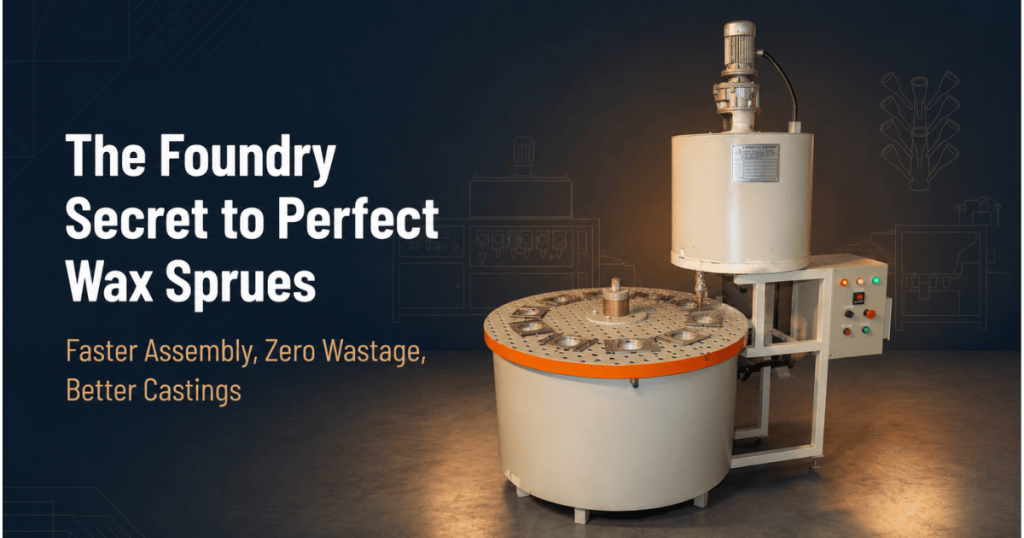
A purpose-built machine like the Laxminarayan sprue maker brings repeatability to a step that punishes inconsistency.
High-Speed, Consistent Output
With a capacity of up to 60 sprues per hour, the machine keeps pace with even busy production lines. Every sprue comes out to the same spec, so your assembly team stops compensating for variation.
Water-Cooled Aluminium Dies
The dies are water-cooled for fast, effective solidification. Quick cooling means faster cycle times and crisp, well-defined pouring cups and tapered sprues, with no waiting around for wax to set.
Full-Length Insert Bars to Cut Wax Waste
This is where the design earns its keep. Full-length metal inserts run through the core of each runner bar, with provision to screw in handles. The inserts drastically reduce wax consumption while adding rigidity to the sprue, so it handles assembly and dipping without sagging.
Built for the Foundry Floor
Constructed from SS304 and MS powder-coated steel with a heated wax tank, a half-HP geared stirrer motor, and a control panel with digital temperature controllers, the whole unit runs on just 3.5 kW. A standard set of 10 dies covers common sprue geometries:
-
Six moulds for 32×32×L300mm tapered sprue with pouring cup
-
Two moulds for 50×50×L350mm tapered sprue with pouring cup
-
Two moulds for 25×75×L300mm rectangular tapered sprue with pouring cup
The Payoff: Fewer Defects, Faster Assembly
When your sprues are uniform, everything downstream gets easier. Assembly is quicker because patterns seat predictably. Metal flow becomes more controlled, which means fewer misruns and cold shuts. And with insert bars slashing wax usage, your material costs drop on every single tree you build.
For a foundry running hundreds of clusters a week, consistent sprues aren’t a nice-to-have. They’re the difference between a stable process and a firefighting operation.
Final Thoughts
The wax sprue maker rarely gets the spotlight, but it quietly sets the ceiling on your casting quality. Precision at the sprue stage flows through every step that follows: assembly, shelling, dewaxing, and pouring. If you’re serious about lowering rejection rates and tightening process control, this is one of the smartest places in the wax room to invest.