
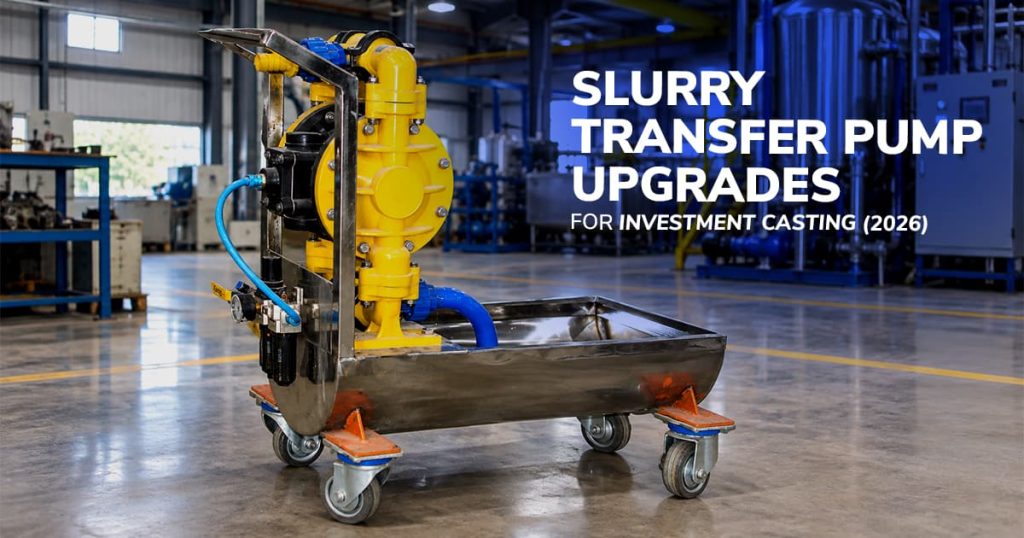
A slurry transfer pump moves abrasive ceramic refractory slurries between primary preparation mixers, conditioning reservoirs, and dipping tanks without shear breakdown or aeration. Built with positive-displacement mechanisms, wear-resistant wetted parts, and variable flow regulation, it prevents particle settling, maintains uniform slurry density, and eliminates manual bucket transfer in precision investment casting shell rooms.
Bucket transfer kills shell-room margins. If operators still haul slurry across the floor in pails, your viscosity logs are fiction. A dependable slurry transfer pump stops that waste before settling ruins your prime coat. At Laxminarayan Technologies, building investment casting equipment since 1986 taught us a hard reality: improper slurry handling damages fluid as fast as bad mixing. Refractory slurry behaves like liquid sandpaper. Treat it carelessly, and it erodes equipment, segregates solids, and wrecks finishes.
A slurry transfer pump is a dedicated foundry slurry transfer system engineered to transport dense, highly abrasive ceramic mixtures such as fused silica, zircon, and colloidal silica binders-between storage and processing tanks while maintaining homogeneous suspension without introducing air bubbles or degrading delicate binder chemistry.
Why Liquid Refractory Movement Dictates Shell Room Yields
Ceramic slurry forgives no mechanical abuse. The moment flow stops, dense zircon flour (specific gravity > ~4.5) drops out. Tanks can quickly stratify into thin binder up top and concrete-hard sediment below.
Here’s the thing. Standard pumps fail in a shell room. Centrifugal impellers spinning at 1450 or 2900 rpm shear delicate polymer chains in water-based binders. Shearing heats the batch, water evaporates, viscosity spikes, and micro-bubbles get whipped into the fluid. Those bubbles cling to wax trees like barnacles, producing positive metal defects on final castings.
Look at the mechanics. A proper ceramic shell slurry pump runs at low velocities, pushing abrasive mixtures through lines using gentle displacement. Solids remain suspended, binders stay stable, and shell thickness stays identical whether dipped at dawn or midnight.
2026 Engineering Upgrades: What Modern Foundries Demand
Over four decades commissioning turnkey lines, we watched crews rebuild centrifugal pumps every three weeks. That headache ends with purpose-built engineering:
-
Trolley-Mounted Slurry Pump Mobility: Shell room floor space is tight. Mounting the drive, pump, and controls on a mobile stainless trolley lets one unit service multiple reservoirs and dipping tanks with quick washes between shifts.
-
Hardened Wear Parts and Low-Shear Geometries: Abrasive flours strip cast-iron impellers bare. Modern units use non-wetted drives, heavy elastomer sleeves, or hardened alloys that shrug off zircon erosion.
-
Variable Flow Inverter Control: Fast bulk transfers require high volume (up to 120 L/min), while topping off dipping tanks demands a gentle trickle (10–15 L/min). Digital AC drives let operators dial in exact flow rates.
-
Tool-Free Quick-Disconnect Manifolds: Changing from primary zircon to backup fused silica demands thorough cleaning. Quick-clamp triclover fittings let technicians flush lines in five minutes without hunting for tools.
Technical Comparison: Manual Bucket Transfer vs. Dedicated Slurry Transfer Pump
Foundries often underestimate the true cost of manual slurry handling:
|
Operational Parameter |
Manual Bucket & Ladle Transfer |
Standard Centrifugal Utility Pump |
Trolley-Mounted Slurry Transfer Pump |
|
Slurry Shear & Degradation |
High agitation, air entrapment |
Severe shear; destroys binder polymers |
Ultra-low shear; preserves rheology |
|
Air Entrapment Risk |
Severe (pouring creates bubbles) |
Extreme (vortex cavitation) |
Virtually zero (submerged laminar flow) |
|
Wear Life in Zircon Slurry |
N/A (high operator fatigue) |
150–300 operating hours |
2,500+ operating hours |
|
Labor Requirement |
High (2 operators dedicated) |
Moderate (frequent maintenance) |
Minimal (~40% labor reduction) |
|
Cross-Contamination Risk |
Constant spill and drip hazard |
High line-cleaning downtime |
Rapid 5-minute flushing cycle |
How Slurry Transfer Integrates Across the Lost-Wax Process
A foundry slurry transfer system acts as the circulatory system of your shell room:
-
Pattern Assembly: Patterns from an automated wax injection machine join central downsprues made on an automated wax sprue maker.
-
Slurry Preparation: Refractory powders and colloidal silica blend in primary or secondary mixers until fully wetted.
-
Conditioned Transfer: A mobile slurry transfer pump delivers homogeneous slurry directly into slurry pots without splashing.
-
Dipping and Stuccoing: Wax clusters immerse into rotating tanks, followed immediately by rainfall sand application.
-
Controlled Drying: Wet shells dry in regulated rooms (22°C, 50% RH) to bond colloidal networks.
-
Thermal Dewaxing: Dried shells enter an inert gas flash dewax system or autoclave, clearing wax without shell cracking.
- Firing and Pouring: Fired shells receive molten superalloys.
Real-World Applications: Where Slurry Integrity Is Non-Negotiable
Demanding casting sectors cannot tolerate inclusions, blisters, or weak shell walls:
-
Aerospace Turbine Blades and Vanes: Single-crystal blades require pristine prime coats. Pumped micro-bubbles create positive metal bumps that violate aerodynamic limits.
-
Industrial Gas Turbine (IGT) Castings: Heavy turbine parts demand dipping tanks holding over 1,500 kg of slurry. Mobile pumps replenish tanks quickly during multi-dip cycles without halting lines.
-
Orthopedic Knee and Hip Implants: Medical cobalt-chrome castings demand zero inclusions. Sealed fluid transfer prevents exposure to airborne shop dust.
-
Stainless Valve Bodies: Heavy fluid-handling valve castings require uniform backup coats to resist metallostatic pressure without mold distortion.
Solving Foundry Bottlenecks: Real Floor Challenges and Solutions
Operating an active shell room exposes harsh equipment realities:
Abrasive Seal Failure and Leakage
Mechanical seals on conventional pumps shred when ceramic grit grinds against spinning shafts. We eliminate rotating seals in fluid contact zones, using sealless displacement designs that prevent slurry weeping onto shop floors.
How to Transfer Ceramic Slurry Without Settling
When lines run too long or velocity drops below critical thresholds, heavy zircon drops out inside hoses. Our systems use smooth-bore anti-static hoses paired with calculated laminar flow rates, keeping aggregate suspended from mixer to dipping tank.
Power Waste and Maintenance Downtime
Oversized utility pumps waste power while generating fluid heat. Modern drive packages yield up to 50% power savings across shell cells, while quick-strip wear parts cut maintenance overhead by ~40%.
Building an End-to-End Precision Foundry
A casting line is only as reliable as its weakest link. You can invest in pristine superalloys, but erratic slurry transfer quietly erodes profit with scrap. Since 1986, Laxminarayan Technologies has delivered ISO 9001 certified machinery, refractories, and turnkey foundry installations worldwide. From wax tooling to automated shell cells, we engineer equipment for four decades of dependable operation. Connect with our engineering specialists or plan a facility visit via Google Maps to review your layout.
Frequently Asked Questions
What makes a trolley-mounted slurry transfer pump for investment casting superior to stationary piping?
A trolley-mounted slurry transfer pump offers total flexibility across crowded shell rooms. Instead of costly, settling-prone permanent piping, one mobile unit wheels between mixers and dipping stations. Quick-disconnect fittings enable rapid water flushing, preventing slurry drying inside the pump body.
How do you prevent air entrapment when transferring ceramic slurry?
Preventing air requires low-shear pumping and submerged discharge lines. Never allow slurry to free-fall or splash into dipping tanks. A variable-speed displacement pump provides laminar entry beneath the fluid level, stopping bubble formation that leads to shell blisters.
What is the best slurry transfer pump for foundry dipping tanks?
The best choice is a sealless, low-shear positive-displacement pump with wear-resistant elastomer or hardened stainless components. It must include variable-speed control to balance high-volume bulk transfer with gentle, non-turbulent tank replenishment during active shifts.
How often do slurry pump wear parts need replacement in zircon service?
In heavy zircon flour service (specific gravity 4.5+), standard centrifugal pumps require seal and impeller replacements every 150 to 300 hours. Purpose-built low-shear transfer pumps with hardened wear paths or elastomeric liners operate reliably for 2,000 to 3,000 operating hours before maintenance.