
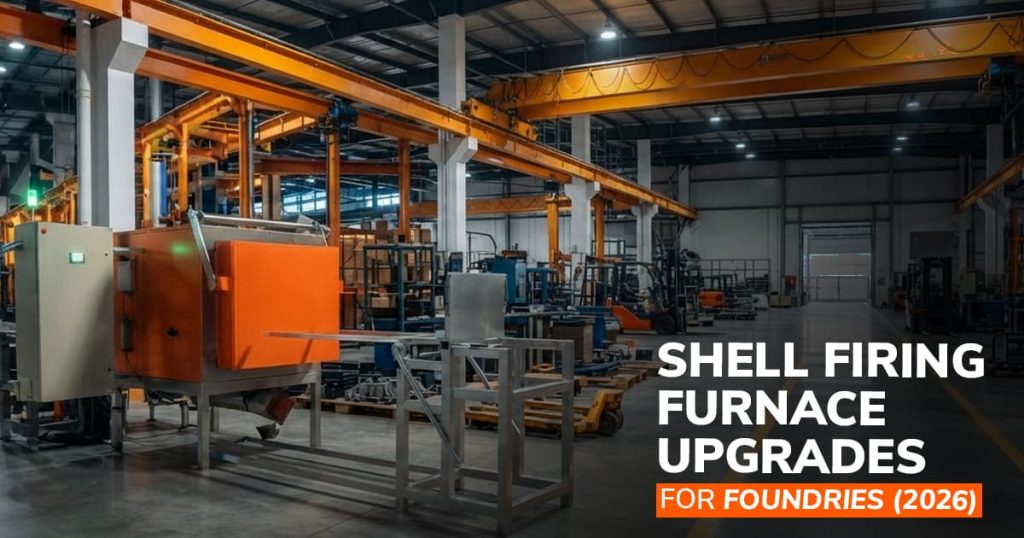
A shell firing furnace sinters green ceramic moulds, eliminates carbon residue, and preheats shells to 950°C–1150°C before alloy pouring. Built with high-velocity burners, low-thermal-mass ceramic fibre insulation, and automated temperature profiling, it ensures full refractory binder conversion, prevents thermal shock, and eliminates misruns in precision investment casting foundries.
Cold shells crack, and cold metal freezes mid-cavity. A shell firing furnace determines final mould integrity. If your furnace runs uneven hearth temperatures or incomplete burnout cycles, residual wax ash ruins casting surface finishes and cold spots trigger catastrophic non-fill scrap. At Laxminarayan Technologies, building investment casting equipment since 1986 taught us that shell baking is a strict chemical transformation. Treat it lightly, and moulds fail under pouring pressure or generate inclusions that scrap costly superalloys.
A shell firing furnace is a dedicated investment casting furnace engineered to burn out residual organic wax, fully sinter colloidal silica and aluminosilicate binder networks, and preheat ceramic shells to tapping temperatures 950°C to 1150°C before molten metal enters the mould cavity.
Why Thermal Uniformity in Shell Preheating Dictates Pour Yields
Pouring molten superalloys at 1550°C into a ceramic shell of non-uniform temperature invites disaster. If one side sits at 1050°C while shadowed areas linger at 800°C, incoming metal solidifies erratically. Thin trailing edges freeze early, grain structures skew, and contraction tears the casting apart.
Here’s the thing. Ceramic shells are poor thermal conductors. Fused silica and zircon resist rapid heat soak. Blasting green shells with localized flames causes outer coats to expand violently while inner coats stay cool. Shells crack along corners before metal touches the cup.
Look at the high-temperature chemistry. Sintering demands two distinct thermal stages: complete carbon burnout (600°C–800°C) under oxidizing conditions, followed by ceramic bonding and crystallization up to 1150°C. If furnace atmospheres lack oxygen during burnout, trapped carbon stays inside shell walls. Molten steel hitting residual carbon boils off gas, creating severe porosity and casting scabs.
2026 Engineering Upgrades: What Modern Foundries Demand
Foundries have retired leaky brick kilns. Over four decades commissioning lines worldwide, we replaced dozens of fuel-wasting units with engineered thermal systems:
- Low-Thermal-Mass Ceramic Fibre Linings: Heavy firebrick absorbs fuel for hours before heating the chamber. Modern shell sintering furnace units use ceramic fibre modules (1400°C rating), cutting cold-start preheat cycles to 45 minutes while yielding ~50% fuel savings.
- High-Velocity Recuperative Burners: Stratified heat creates cold floor zones. Multi-burner arrays drive high-velocity swirl patterns, wrapping heat around nested clusters without flame impingement.
- Rotary Hearth and Bogie Automation: Handling red-hot shells manually drops temperature by 100°C every 30 seconds. A continuous rotary hearth shell furnace indexes hot moulds directly to pouring lines, cutting critical transit times and minimising atmospheric chilling.
- Digital Multi-Zone PLC Profiling: Modern alloys demand repeatable recipes. Integrated controllers monitor multi-zone thermocouples, ramping temperatures safely through quartz inversion phases.
Technical Comparison: Batch Box Kiln vs. Modern Shell Firing Furnace
Choosing an inefficient furnace architecture inflates foundry energy bills, slows cycle times, and fills scrap bins with cracked shells:
|
Operational Parameter |
Legacy Brick Box Kiln |
Standard Chamber Furnace |
High-Efficiency Shell Firing Furnace |
|
Lining Material |
Heavy dense firebrick |
Mixed brick and blanket |
Low-thermal-mass ceramic fibre modules |
|
Cold Start to 1050°C |
3.5 to 5.0 hours |
2.0 to 2.5 hours |
40 to 55 minutes |
|
Temperature Uniformity |
±35°C (severe cold corners) |
±15°C to ±20°C |
±5°C across the working hearth |
|
Fuel / Power Consumption |
High baseline heat loss |
Moderate thermal retention |
~50% savings via recuperation |
|
Mould Transfer Method |
Slow manual tongs |
Manual trolley |
Automated rotary hearth or pneumatic bogie |
How Shell Firing Integrates Across the Lost-Wax Process
A ceramic shell baking furnace represents the final thermal gate before casting:
-
Pattern Assembly: Precision patterns and an automated wax sprue maker join runners on an ergonomic assembly table.
-
Shell Building: Clusters dip through slurries and stucco beds, building structural wall thickness.
-
Dewaxing: Green shells enter an inert gas flash dewax system or autoclave to clear wax safely.
-
Sintering and Preheating: Dewaxed moulds transfer into the shell firing furnace for carbon burnout and refractory bonding.
-
Pouring: Red-hot moulds transfer to pouring stations, receiving alloys without temperature drop.
-
Knockout: Cooled castings move to mechanical knockout and finishing.
Real-World Applications: Where Shell Temperature Control Is Non-Negotiable
Demanding investment casting sectors cannot tolerate temperature drops or residual shell carbon:
-
Aerospace Turbine Blades and Vanes: Thin trailing edges (under 0.8 mm) require uniform shell preheating up to 1100°C. Cold mould corners cause immediate alloy freeze-off, scrapping expensive vacuum-melted nickel superalloy heats.
-
Industrial Gas Turbine (IGT) Segments: Heavy structural turbine components demand deep thermal soaking across thick ceramic cross-sections to ensure uniform equiaxed or directionally solidified grain formation.
-
Orthopedic Joint Implants: Cobalt-chromium medical implants demand clean carbon burnout. Trace carbon ash in a poorly sintered shell causes microscopic surface pits that fail stringent biocompatibility standards.
-
Thin-Walled Stainless Impellers: Complex internal flow passages depend on sustained shell preheats to achieve sharp blade profiles without misruns or cold shuts.
Solving Foundry Bottlenecks: Real Floor Challenges and Solutions
Operating high-temperature burnout equipment reveals floor hurdles:
Shell Cracking During Rapid Heat-Up
Silica refractories undergo volumetric crystalline expansion at 573°C during alpha-to-beta quartz inversion. Heating too quickly through this narrow thermal window shatters brittle green shells. We program ramp profiles that step gently through critical inversion points before accelerating to 1100°C.
Heat Loss During Mould Transfer
Red-hot shells lose 80°C to 120°C within 45 seconds of leaving furnace doors. Chilled shells produce misruns. Our fast-acting pneumatic doors and transfer mechanisms cut transfer cycles under 15 seconds, preserving critical mold heat.
High Fuel and Maintenance Costs
Old atmospheric burners waste fuel through exhaust stacks, and spalling bricks require frequent rebuilds. Modern recuperative burners preheat combustion air with exhaust gas, yielding 50% fuel savings and cutting maintenance by ~40%.
Building an End-to-End Precision Foundry
A casting defect at the pouring floor scraps the accumulated manufacturing value of your entire plant. Since 1986, Laxminarayan Technologies has delivered ISO 9001 certified machinery, specialized refractories, and turnkey foundry installations worldwide. From pattern tooling to high-temperature sintering furnaces, we build equipment for four decades of dependable production. Connect with our engineering specialists or plan a visit via Google Maps to discuss your layout.
To know more visit @ https://www.ic-machines.com/