
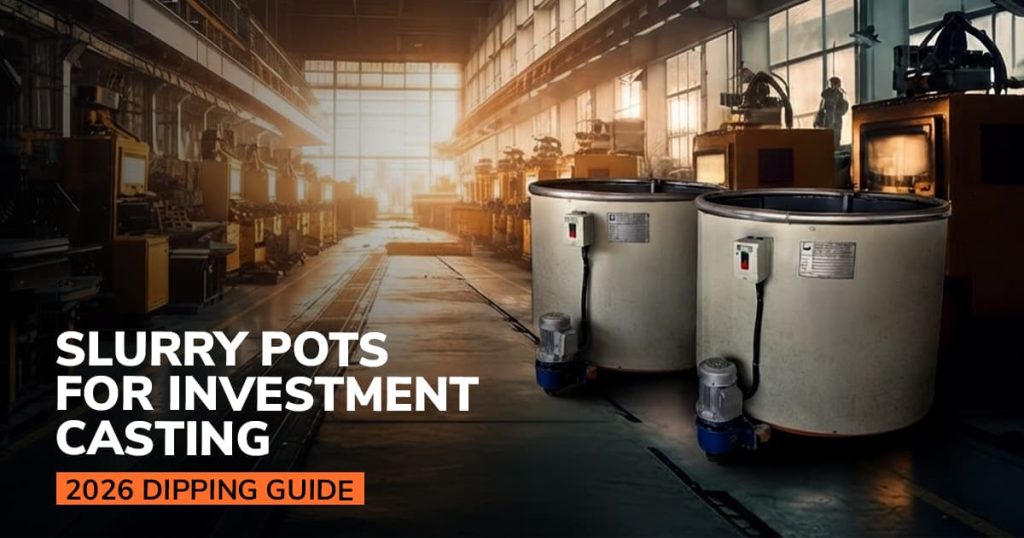
Slurry pots for investment casting maintain refractory slurries in continuous, non-turbulent suspension to coat wax patterns uniformly during shell building. Engineered with rotating cylindrical drums, smooth polypropylene linings, and variable-speed drives, they eliminate dead zones, prevent particle settling, and minimize evaporation across prime and backup dipping cycles.
Your casting finish is decided long before the pour. It is locked in the shell room. If your slurry pots for investment casting allow refractory flours to settle or crust around the tank rim, no amount of downstream grinding can fix the resulting inclusions. At Laxminarayan Technologies, building investment casting equipment since 1986 taught us that shell consistency begins with controlled, laminar slurry movement. A poorly mixed pot acts like an unmixed paint can: thin binder on top, dense aggregate settled hard at the bottom.
Slurry pots for investment casting are dedicated rotating cylindrical tanks designed to maintain ceramic slurries (fused silica, zircon, or alumina in colloidal silica binders) in a homogeneous, lump-free state without introducing air bubbles during manual or robotic wax tree dipping.
Why Slurry Rheology and Tank Dynamics Make or Break Shells
A precision ceramic shell is a delicate laminate. It must withstand high-temperature molten metal at 1600°C without cracking or distorting under pressure. That vital balance hinges on slurry rheology.
Here’s the thing. Ceramic slurry is unstable. Dense zircon flour (specific gravity ~4.5) settles the moment fluid movement stops. Run a high-speed impeller in a stationary tank and you whip air into the binder. Micro-bubbles cling to wax trees like barnacles, creating positive metal defects and blistered casting surfaces.
Look at the mechanics. Rotating slurry tanks turn the entire vessel slowly against stationary contoured baffles. Fluid motion stays smooth and laminar. Solids remain suspended without breaking the liquid surface or driving off volatile binders.
2026 Engineering Upgrades: Inside Next-Gen Rotating Slurry Pots
Old fabricated steel tanks belong in the scrap yard. Over four decades on foundry floors, we replaced hundreds of obsolete units that contaminated slurries with iron particles. Modern dipping cells demand purpose-built metallurgy:
-
SS304 Rotating Slurry Pot with Polypropylene Lining: Rigid SS304 outer shells support a smooth polypropylene liner that eliminates slurry adhesion, stops iron contamination, and speeds washdowns.
-
Precision Variable-Speed Inverter Drives: Digital AC drives tune speed between 5 and 40 rpm. Fast rotation keeps dense zircon suspended; slow overnight idling prevents skinning while saving electricity.
-
Water Cooling with Chiller Integration: Integrated heat exchanger circulate chilled water (18°C–22°C), preventing ambient heat from driving up binder viscosity.
-
Cantilevered Baffle Systems: Tool-free removable baffles eliminate submerged bearings that freeze under abrasive grit. Operators pull baffles out in seconds.
Standard Specifications: Slurry Pot Sizes for Investment Casting Foundry (600–1800 mm)
Matching pot diameter and depth to your maximum wax cluster envelope prevents edge clipping and poor corner coverage:
|
Vessel Diameter |
Usable Slurry Depth |
Slurry Capacity (Approx.) |
Drive Power |
Shell-Room Application |
|
600 mm (24″) |
5 600 mm |
~120 kg |
0.75 kW |
Medical implants, turbocharger wheels |
|
900 mm (36″) |
750 mm |
~380 kg |
1.1 kW |
Commercial valves, pump impellers |
|
1200 mm (48″) |
900 mm |
~850 kg |
1.5 kW |
Automotive manifolds, structural hardware |
|
1500 mm (60″) |
1100 mm |
~1,600 kg |
2.2 kW |
Large turbine blades, heavy pump housings |
|
1800 mm (72″) |
1300 mm |
~2,800 kg |
3.7 kW |
Robotic dipping cells, heavy aerospace and IGT parts |
How Slurry Pots Integrate Across the Complete IC Shell Room
A dipping tank connects pattern prep, shelling, and thermal dewaxing:
-
Wax Tree Assembly: Patterns from an automated wax injection machine join runners extruded on an automated wax sprue maker.
-
Primary Slurry Dipping: Wax clusters submerge into a dedicated slurry dipping pot filled with fine zircon flour Slurry.
-
Rainfall Stuccoing: Coarse refractory grain rains onto the Slurry wet wax trees wet.
-
Controlled Shell Drying: Clusters dry in climate-controlled rooms (23°C, 50% RH) to bond silica networks.
-
Backup Dipping Cycles: Repeat dips through secondary ceramic slurry mixing equipment build structural shell thickness.
-
Flash Dewaxing: Dried shells enter an inert gas flash dewax system or autoclave, clearing wax without cracking.
-
Firing and Pouring: Fired shells receive molten superalloys.
Real-World Applications: Where Slurry Homogeneity Is Non-Negotiable
Uniform ceramic slurry coating directly dictates casting yield across demanding sectors:
-
Aerospace Turbine Blades and Guide Vanes: Nickel superalloys cast into shells with prime-coat defects pit easily. Controlled rotation keeps fine flours homogeneous for smooth root surfaces.
-
Industrial Gas Turbine (IGT) Parts: Large turbine assemblies require clusters over 1.2 meters. Heavy 1500–1800 mm pots provide deep immersion without rim turbulence.
-
Orthopedic Joint Implants: Cobalt-chrome implants demand zero inclusions. Polypropylene liners eliminate tank friction, preventing foreign particle pickup.
-
High-Pressure Valve Bodies: Stainless valve castings rely on uniform backup coats to stop shell bulging under liquid metal weight.
Foundries planning dipping room expansions can inspect our complete range of slurry pots for investment casting to match tank dimensions with specific robotic arm payloads.
Solving Foundry Bottlenecks: Floor Realities and Practical Fixes
Running a shell room three shifts a day exposes common process failures:
Slurry Skinning and Evaporation
Drafts sweeping over open tanks dry slurry surfaces into hard flakes. These flakes redeposit on wax trees, causing inclusions. We fit split covers and low-profile tank lips to stop draft-induced skinning.
Settling in Dead Corners
Flat-bottom stationary tanks trap slurry in bottom corners. Top liquid thins while aggregate packs below. Our dished bottom geometry and parabolic baffles drive continuous toroidal turnover without foaming.
Power Waste and Labor Overhead
Manual stirring produces erratic viscosity logs. High-efficiency geared drives deliver ~50% power savings over old agitators, while quick-clean tank designs reduce shell-room labor by ~40%.
Building an End-to-End Precision Foundry
A reject caused by a flaking shell costs just as much as a scrap caused by bad furnace metallurgy. Since 1986, Laxminarayan Technologies has engineered ISO 9001 certified machinery, refractories, and turnkey foundries across the globe. From wax room automation to robotic shell room dipping cells, we build machinery designed for four decades of continuous production. Connect directly with our engineering specialists or navigate via Google Maps to schedule an in-depth technical consultation at our Kolhapur manufacturing facility.
Frequently Asked Questions
Why are rotating slurry tanks preferred over stationary mixer tanks for dipping?
Rotating slurry tanks turn the drum around fixed baffles at gentle speeds (15–35 rpm). This maintains uniform suspension without whipping air bubbles into colloidal binders. High-speed stationary propellers create turbulent vortexes that trap air, causing casting voids and blisters.
What are the standard slurry pot sizes for investment casting foundry operations?
Standard slurry pot sizes range from 600 mm to 1800 mm in diameter. Smaller 600–900 mm units suit manual dipping of medical implants and hardware. Larger 1200–1800 mm pots accommodate heavy structural wax clusters and multi-axis robotic dipping cells in aerospace and automotive foundries.
What is the benefit of a polypropylene lining inside an SS304 slurry pot?
An SS304 rotating slurry pot with polypropylene lining combines structural steel rigidity with a smooth, chemically inert plastic interior. The liner helps remove dry slurry crusts easily and eliminates the fatigue involved in such maintenance activity, it also allows fast washdowns when changing ceramic formulations.
How does slurry temperature affect shell-building consistency?
Ceramic slurries containing colloidal silica binders are sensitive to temperature. If slurry warms above 25°C, water evaporates quickly, and viscosity climbs erratically. Water cooled slurry pots hold stable operating temperatures (18°C–22°C), preserving predictable ceramic coating thickness on every dip.
-
Meta Title: Slurry Pots for Investment Casting: 2026 Dipping Guide
-
Meta Description: Rotating slurry pots for investment casting by Laxminarayan Technologies. SS304 construction, polypropylene lining, and sizes from 600 mm to 1800 mm.