
In investment casting, ceramic shell quality begins with slurry consistency. If the slurry is not properly mixed, solids can settle, viscosity can change, and the refractory coating may become uneven. These issues can affect shell strength, surface finish, dimensional accuracy, and casting quality.
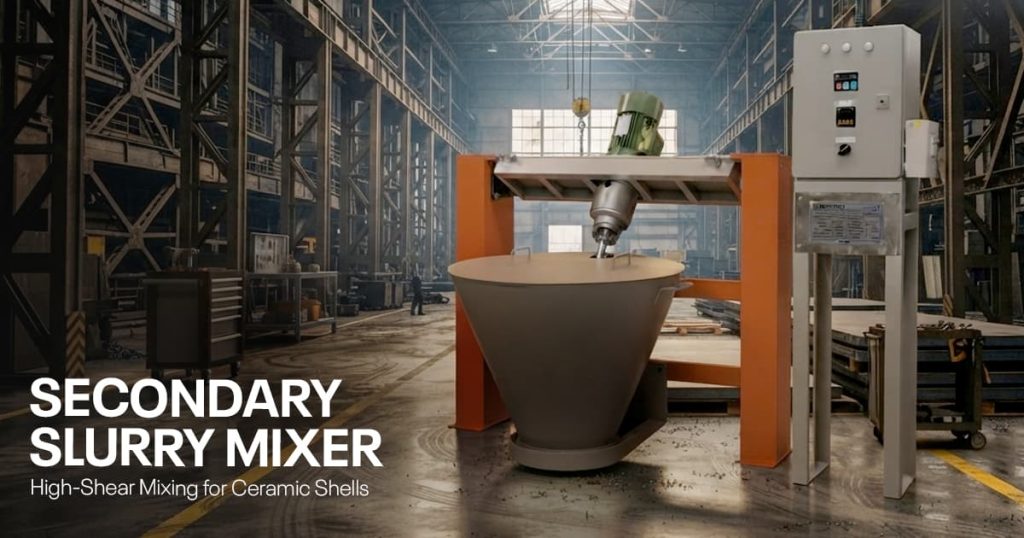
A modern Secondary Slurry Mixer helps foundries formulate and prepare the secondary slurry for shell building. The Secondary Slurry Mixer from Laxminarayan Technologies is designed with a conical mixing vessel, variable-speed agitation, high-shear mixing capability, and digital timer control for reliable investment casting applications.
What Is a Secondary Slurry Mixer?
A secondary slurry mixer is used to keep ceramic slurry thoroughly blended and ready for shell coating operations.
Unlike basic stirring systems, a high-shear secondary slurry mixer creates stronger agitation within the vessel. This helps improve the circulation of the slurry and supports a more uniform mixture throughout the tank.
The conical vessel design also encourages continuous turnover of the slurry volume, helping reduce dead zones and material settling.
Why Slurry Consistency Matters in Investment Casting
Ceramic slurry is made from a combination of refractory materials, binders, solvents, and other process additives. These components must remain properly dispersed during production.
Poor slurry control can lead to:
-
Uneven shell thickness
-
Inconsistent stucco adhesion
-
Surface defects on castings
-
Reduced shell strength
-
Excessive material usage
-
Variation between production batches
-
Increased rework and rejection rates
A dedicated secondary slurry mixer gives operators better control over the condition of the slurry before and during shell application.
How the Laxminarayan Secondary Slurry Mixer Works
The mixer uses a vertical conical drum fitted with a retractable propeller. The propeller produces high-shearing forces that agitate the slurry and help create a thorough mix.
The equipment is available in configurations capable of handling up to 300 kg or up to 600 kg at approximately 75% usable vessel volume, depending on the model and formulation.
A variable-frequency drive allows stepless speed control. Operators can select higher speeds for high-shear mixing or lower speeds for gentle stirring when the slurry formulation requires controlled agitation.
Key Features of the Secondary Slurry Mixer
Conical Mixing Vessel
The conical tank shape supports continuous slurry turnover. This helps maintain a more uniform mixture throughout the vessel and can reduce settling at the bottom.
Variable-Speed Propeller
The propeller speed can be adjusted for different slurry formulations and process stages. High-speed mixing can be used when stronger agitation is required, while gentle stirring can help maintain slurry stability during holding periods.
High-Shear Mixing
The propeller design generates high-shearing forces to support thorough mixing of ceramic slurry. This is useful for foundries working with demanding refractory formulations.
Digital Timer Control
The control system includes a MIX function that operates the mixer for a preset duration. The selected mixing time is set and displayed digitally, while tower lights indicate the end of the cycle.
Retractable Stirrer Design
The retractable stirrer configuration can make vessel access and cleaning more practical, depending on the selected machine design.
Stable Bearing and Drive Arrangement
The stirrer shaft is pretensioned between taper roller bearings installed inside a cast-iron bearing box. The drive motor is mounted on this bearing arrangement for reliable operation.
Industrial Construction
The mixer is designed for foundry environments, with a separate steel structure, protected control cabinet, and appropriate motor protection.
Technical Specifications
The available specifications include:
-
Slurry capacity up to 300 kg, depending on formulation
-
Larger configuration up to 600 kg at approximately 75% usable volume
-
Approximate overall size: 1200 mm × 1200 mm × 1500 mm
-
1.5 HP, 900 rpm, three-phase stirrer motor in the standard configuration
-
Variable-frequency drive for stepless speed control
-
High-shear and gentle-stirring modes
-
Digital timer-based mixing control
-
Separate dust-proof control cabinet
-
Motor protection through contactor and MPCB systems
Actual capacity and configuration should be selected according to slurry formulation, production volume, vessel usage, and shell room layout.
Frequently Asked Questions About Secondary Slurry Mixers
What is a secondary slurry mixer used for?
A secondary slurry mixer is used to mix continuously and condition ceramic slurry before it is applied to wax patterns during investment casting.
What is the difference between a primary and secondary slurry mixer?
A primary mixer is used for preparing the Primary slurry, while a secondary mixer is to prepare the Secondary or Backup slurry. The Primary slurry mixer requires about 48 – 72hrs. mixing time whereas the Secondary slurry mixing time can be 20-30mins.
Why is a conical vessel useful for slurry mixing?
The conical shape encourages continuous movement of the slurry volume and helps reduce material settling and stagnant areas inside the tank.
Can the mixing speed be adjusted?
Yes. A variable-frequency drive allows stepless speed control, supporting both high-shear mixing and gentle stirring.
What capacity is available?
The standard configuration can hold up to 300 kg of slurry, depending on the formulation. A larger design can accommodate up to 600 kg at approximately 75% usable vessel volume.
Is the mixing time programmable?
Yes. The digital timer allows operators to set a preset mixing duration, with the end of the cycle indicated through tower lights.
Why Foundries Are Upgrading Slurry Management
Modern investment casting operations are moving toward better process control, lower material waste, and more repeatable shell quality. Slurry management is a key part of this upgrade.
A modern secondary slurry mixer helps support:
-
More consistent slurry viscosity
-
Better refractory dispersion
-
Improved coating repeatability
-
Reduced manual intervention
-
Easier process standardisation
-
Better control over production batches
-
More efficient use of ceramic materials
The biggest improvement is not just faster mixing. It is predictable slurry behaviour across the shellroom.
Machines That Work Well with a Secondary Slurry Mixer
Foundries purchasing a secondary slurry mixer often need supporting equipment to create a complete and efficient shell-building line.
Slurry Transfer Pump
A Slurry Transfer Pump moves prepared slurry directly to storage tanks or in-cell dipping tanks.
Its trolley-mounted design allows one unit to serve multiple areas of the shellroom. This is useful when foundries work with different slurry compositions and require intermittent washing between transfers.
Slurry Pots
Slurry Pots can support controlled slurry handling at individual dipping stations. They are useful for organising the delivery and application of slurry within the shell-building area.
Rainfall-Type Stucco Applicator
After dipping, the wet cluster needs an even coating of refractory particles. A Rainfall-Type Stucco Applicator creates a controlled and uniform sand rain around the cluster.
This can reduce spillage of expensive refractory material and support more consistent shell layers.
Fluidised Bed Stucco Applicator
A Fluidised Bed Stucco Applicator is another option for applying refractory particles to wet slurry-coated clusters. It can be considered for foundries looking to improve stucco application consistency and production flow.
Robotic Shell Building
For high-volume or automation-focused operations, Robotic Shell Building can help reduce manual handling and create a more repeatable shell coating process.
A consistent slurry supply is essential for automation. If slurry properties change from one cycle to another, even advanced handling equipment cannot deliver stable results.
Supporting Global Investment Casting Requirements
Laxminarayan Technologies is based in Kolhapur, Maharashtra, India, and develops machinery for investment casting foundries in India and international markets.
The company’s equipment portfolio covers key stages of the process, including:
-
Wax preparation
-
Wax injection
-
Ceramic core manufacturing
-
Slurry preparation
-
Shell building
-
Dewaxing
-
Shell firing
-
Knockout and finishing
For international buyers, machine selection should consider local electrical standards, production capacity, installation requirements, operator training, spare parts, and after-sales support. A properly specified slurry mixer can be integrated into both new foundry projects and existing shellroom upgrades.
How to Select the Right Secondary Slurry Mixer
Before selecting a model, evaluate the following:
-
Slurry formulation: Different formulations may require different mixing speeds and agitation patterns.
-
Working capacity: Select a vessel size based on usable volume, not only total vessel volume.
-
Required mixing mode: Confirm whether the process needs high-shear mixing, gentle stirring, or both.
-
Daily production volume: Higher production may require larger capacity or multiple mixers.
-
Cleaning requirements: Consider how easily the vessel and propeller can be accessed between batches.
-
Shellroom layout: Check the available height, floor area, and connection points.
-
Automation goals: Digital timing and speed control can support process standardisation and future upgrades.
Build a More Controlled Shellroom
A consistent ceramic shell depends on more than the dipping operation. It depends on how the slurry is prepared, mixed, transferred, stored, and applied.
The Secondary Slurry Mixer provides a practical way to improve slurry conditioning through controlled agitation, adjustable speed, digital timing, and conical vessel geometry. When integrated with a slurry transfer pump, stucco applicator, slurry pots, and automated shell-building equipment, it can help create a more stable and modern investment casting shellroom.
Explore the complete IC Machines machinery range or contact Laxminarayan Technologies to discuss the right slurry mixing configuration for your foundry.