
Ask any seasoned foundry engineer where investment casting quality really begins, and they won’t point to the furnace. They’ll point to the slurry. Specifically, the primary slurry, the very first coat that touches your wax pattern and defines the surface finish of every casting that follows.
And the machine that makes or breaks that first coat? The primary slurry mixer.
What Is a Primary Slurry Mixer?
A primary slurry mixer is the machine used to formulate and thoroughly blend ceramic investment slurry to a precise, repeatable consistency. In investment casting, the wax assembly is dipped into this slurry to build the first, most critical layer of the ceramic shell.
Get that prime coat right and you get crisp detail, smooth surfaces, and dimensionally accurate parts. Get it wrong and the defects are baked into every shell.
Why the Horizontal Rotary Barrel Design Wins
Not all mixers handle prime slurry equally. The horizontal rotary barrel design is the preferred choice for primary slurry, and for good reason. It subjects the formulation to continuous, gentle mixing action while avoiding the problems that ruin slurry:
-
No heat buildup that alters viscosity mid-batch
-
Minimal evaporation, so the slurry composition stays stable
-
Little to no foaming, which means fewer trapped-air defects in the shell
This rotating horizontal vessel blends slurry to the required viscosity and ratio in the shortest possible time, with minimal labour. That combination of speed, consistency, and low operator input is exactly what a busy shellroom needs.
Key Features That Matter
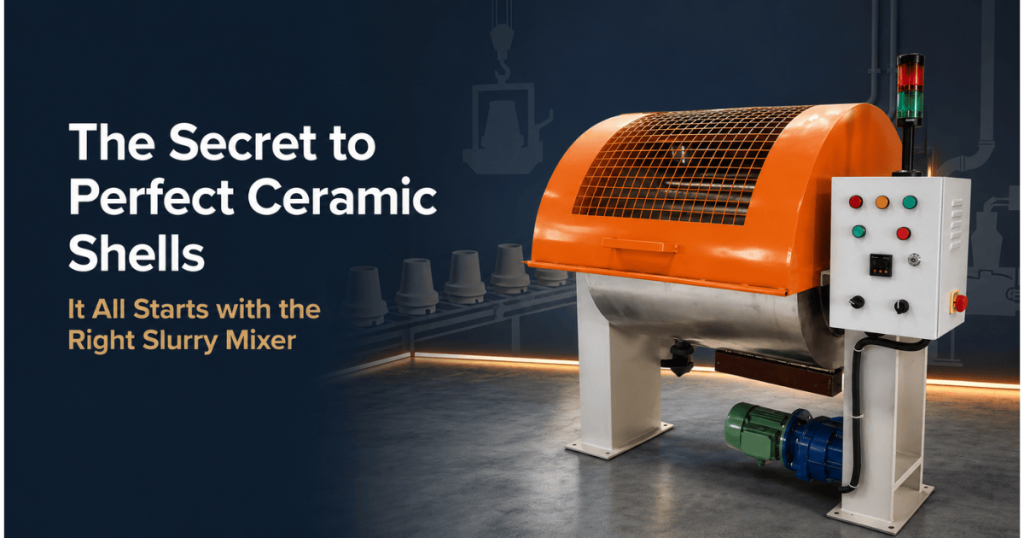
The Laxminarayan primary slurry mixer is engineered around reliability and repeatability. Here’s what stands out:
Serious Capacity
The single drum handles up to 600 kg of slurry depending on composition, with a standard rotating barrel model accommodating up to 300 kg. That’s enough to keep even a high-volume shellroom supplied without constant re-batching.
Precise, Programmable Control
-
Mixing time is settable from 1 to 999 hours for full flexibility
-
Runs in both AUTO and Manual modes
-
In AUTO, the machine handles MIX or STORE functions, with cycle completion shown on tower indicator lamps
-
A control panel with MCB, DOL starter, digital timers, and status tower lights keeps operators informed at a glance
Built to Last
-
Cast steel support structure with precision-machined shafts
-
Mounted on frictionless self-aligning bearings for smooth, long-term operation
-
Driven by a 1 HP, 3-phase reduction geared motor with a chain-and-sprocket arrangement and safety cover
Practical, Foundry-Friendly Details
-
A 200mm feed hatch with lid makes loading ceramic investment material easy
-
A PVC ball valve positioned 500mm from ground level allows clean slurry draining
-
Compact 1200 × 1200 × 1200mm footprint fits neatly into most shellrooms
-
Sips power at just 750W
The mixer also integrates smoothly with slurry transfer pumps, so moving conditioned slurry to storage or dipping tanks is seamless.
How It Impacts Your Casting Quality
Ceramic shell quality is directly tied to slurry viscosity and solids content. When the primary slurry is mixed unevenly, you see it in the results:
-
Rough or inconsistent surface finish on castings
-
Uneven prime-coat thickness that weakens the shell
-
Trapped air and foaming defects that cause shell failures
-
Batch-to-batch variation that drives up rejection rates
Continuous, controlled mixing eliminates these variables at the source. A well-formulated prime coat means better surface reproduction, stronger shells, and fewer parts coming back as scrap.
Where It Fits in the Shell Building Process
The primary slurry mixer sits right at the start of the shellroom chain. It formulates the prime coat, which is then applied to the wax assembly, followed by stucco, backup coats, drying, and firing. Because every downstream step builds on that first layer, the mixer effectively sets the ceiling on how good your shells can be.
Final Thoughts
In investment casting, precision compounds. Every accurate step makes the next one easier, and it all traces back to that first ceramic coat. A dependable primary slurry mixer, built for consistent viscosity, low foaming, and repeatable batches, is one of the smartest foundations you can build your shellroom on. If you’re serious about surface finish and lower rejection rates, this is where the work truly starts.