
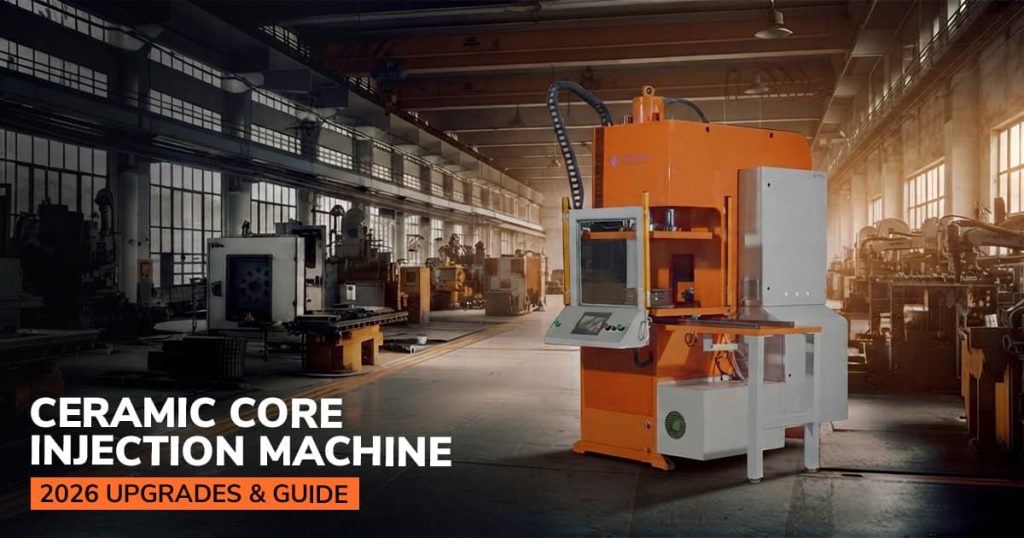
A ceramic core injection machine forms high-precision preformed ceramic inserts that create intricate internal hollows and cooling channels in investment cast components. By injecting ceramic powder and thermoplastic binders under precise pressure and multi-zone thermal control, it produces dimensionally stable cores that dissolve cleanly during post-cast leaching autoclaving.
Scrap rates in precision investment casting don’t start at the pour. They start at the core press. If your ceramic core injection machine yields minor core deflection, you won’t spot the failure until an aerospace blade cracks under testing. At Laxminarayan Technologies, building investment casting equipment since 1986 taught us a hard truth: you cannot salvage ruined internal passages with downstream rework. Precision internal geometry demands rigid injection equipment that resists abrasive ceramic wear day after day.
A ceramic core injection machine is dedicated investment casting equipment designed to inject abrasive ceramic powder compounded with thermoplastic binders into hardened dies. It produces rigid, near-net-shape refractory cores capable of withstanding molten superalloy temperatures without deforming, before chemical leaching.
Why Core Repeatability Dictates Modern Foundry Profitability
Turbine cooling circuits push casting boundaries. When molten nickel superalloys hit shells at 1450°C, ceramic cores endure violent thermal stresses. Core wall shifts of ±0.08 mm alter airflow enough to scrap rotor sets.
Here’s the thing. Ceramic feedstock behaves nothing like standard pattern wax. Gritty, sluggish, and intensely abrasive. Feedstock acts like liquid sandpaper flowing through hydraulic passages. If your injection press lacks adequate clamping rigidity, the die separates by microscopic fractions. Flash forms along parting lines. Flash means costly deburring, broken pins, and scrap.
Our engineering focus on 20T to 100T presses eliminates platen deflection under sustained pressure. Stable clamping protects expensive multi-cavity dies while preserving tight internal tolerances across multi-shift runs.
2026 Upgrades: What Separates Advanced Ceramic Injectors From Legacy Presses?
Foundries have abandoned guesswork. Over four decades, our commissioning teams replaced dozens of converted wax presses retrofitted for ceramic cores:
-
Multi-Zone Temperature Controlled Ceramic Injector Architecture: Ceramic matrices require staged heating. Cold nozzles cause knit lines; overheated barrels degrade binders. Multi-zone thermal control stabilizes viscosity across the barrel.
-
Motorized X-Z Settable Nozzle Positioning: Tooling geometry differs between stator vanes and impellers. Motorized X-Z nozzle adjustment aligns the injection tip without shimming tooling manually.
-
Hardened Wear-Resistant Contact Metallurgy: Tooling steels wash out quickly under abrasive ceramic flow. Surface-hardened contact alloys preserve orifice geometry and maintain calibrated velocity across million cycles.
-
Digital Hydraulics and Volume-Based Shots: Relying on line pressure creates density variations. Digital hydraulics meter stroke displacement to fractions of a cubic centimeter, preventing flash and sink.
Technical Specifications: CxxTSA Series Comparison
Selecting the right press tonnage prevents premature die wear and dimensional distortion:
|
Machine Parameter |
C20TSA (20 Ton) |
C35TSA (35 Ton) |
C50TSA / C100TSA (50–100 Ton) |
|
Primary Application |
Medical implants, turbochargers |
Stator vanes, pump impellers |
Heavy aviation blades, large IGT parts |
|
Shot Capacity |
Up to 1.5 Liters |
Up to 3.5 Liters |
Up to 7.5 Liters (Customizable) |
|
Press Structure |
Heavy-duty C-frame |
Heavy-duty C-frame |
C-frame or 4-Pillar press |
|
Nozzle Alignment |
Manual / Motorized X-Z |
Motorized X-Z standard |
Motorized programmable X-Z |
|
Platen Base |
Ground T-slots |
Ground T-slots |
T-slots with platen cooling |
|
Control System |
PLC Touchscreen HMI |
PLC Touchscreen HMI |
PLC multi-zone diagnostics |
How the Ceramic Core and Lost-Wax Workflow Functions
A ceramic core integrates into a broader foundry ecosystem. Coordinating the core line with adjacent stations balances the wax room:
-
Feedstock Compounding: Fused silica or alumina powders blend with thermoplastic binders in heated mixers until homogeneous.
-
Core Injection: Compounded slurry loads into the ceramic core injection machine, injecting under monitored temperature and hydraulic pressure.
-
Core Sintering: Green cores undergo inspection, debinding, and kiln sintering to gain strength.
-
Wax Pattern Encapsulation: Operators place sintered cores into pattern dies. A high-tonnage wax injection machine injects wax around the core.
-
Slurry Coating and Stuccoing: Assemblies dip into refractory slurries circulated by a dedicated slurry transfer pump, followed by rainfall stuccoing.
-
Dewaxing: Green shells transfer to an autoclave or an inert gas flash dewax system to clear wax safely.
-
Pouring and Core Leaching: Superalloy is cast into fired shells. Solidified castings enter alkaline leaching autoclaves, dissolving ceramic cores completely.
Real-World Applications: Where Precision Ceramic Cores Are Mandatory
High-tonnage ceramic core injection press equipment serves sectors where failure is not an option:
-
Aerospace Turbine Blades and Vanes: Jet engines operate above superalloy melting points, sustained by serpentine cooling passages formed by ceramic cores.
-
Industrial Gas Turbine (IGT) Components: Power turbines require ceramic cores up to 7.5 liters in shot volume, demanding high clamping tonnage to prevent die shifting.
-
Orthopedic Joint Implants: Knee and hip prosthetics demand hollow structures to enhance osseointegration without sacrificing strength.
-
High-Performance Flow Control Valves: Complex internal labyrinths for subsea systems rely on ceramic cores to cast pathways inaccessible by CNC milling.
Foundries upgrading production can inspect our purpose-built ceramic core injection machine to review specific stroke capacities. You can also explore our specialized tooling platforms at ceramicinjector.com for complementary blenders and sintering kilns.
Solving Foundry Bottlenecks: Real Floor Challenges and Fixes
Operating a precision lost-wax foundry reveals operational headaches that catalog brochures overlook:
Abrasive Seal Failure and Pressure Loss
Abrasive dust past piston rings erodes hydraulic packings, causing hold-pressure drops and soft cores. We use isolated seal housings with rapid-change split seals. Crews replace packs without dismounting cylinders.
Core Distortion and Thermal Cracking
Uneven cooling against cold dies warps cores upon ejection. We integrate platen cooling and programmable speeds. Slow fill velocities eliminate air entrapment while steady holding pressure prevents thermal slump.
Energy Inefficiency and Labour Overhead
Old pump sets waste energy idling bypass tanks. Modern electro-hydraulic packages operate on demand, yielding 50% power savings across core processes. Automated nozzle alignment and touchscreen diagnostics cut labor by 40%, letting technicians manage multiple cells.
Building a Dependable Foundry Line
Cutting corners on core equipment creates an invisible tax on your foundry. Every cracked core pin, warped passage, and manual deburring hour eats your operating margin. Since 1986, Laxminarayan Technologies has delivered ISO 9001 certified machinery, refractories, and complete turnkey foundry installations to clients worldwide. From aerospace turbine components to industrial impellers, we build durable equipment for long-term shop-floor reliability. Connect with our team or navigate via Google Maps to plan a facility visit.
Frequently Asked Questions
What clamping force is required for ceramic core injection?
Clamping requirements depend on the projected surface area of the core die and injection pressure. Small medical implants and turbocharger cores generally run on 12T to 20T presses. Large industrial gas turbine blades and multi-cavity aerospace dies require 35T to 100T clamping force to prevent parting-line flash.
How does ceramic core injection differ from wax pattern injection?
Ceramic core injection operates with highly abrasive ceramic slurries that require hardened tool-steel contact parts and multi-zone heating barrels. Wax injection runs at lower temperatures (55°C–70°C) with non-abrasive waxes, requiring specialized paste-wax conditioning rather than high wear-resistant metallurgy.
Why do ceramic cores require specialized chemical leaching autoclaves?
Ceramic cores cannot be melted out like pattern wax. After casting molten metal around the core, the solid ceramic must be dissolved using heated, pressurized sodium hydroxide or potassium hydroxide solutions inside an autoclave. This chemical reaction removes the core without attacking the parent superalloy.
Can standard hydraulic presses be retrofitted for ceramic core injection?
Retrofitted hydraulic presses typically fail because standard pumps lack micro-metered digital volume control. Standard barrels wash out quickly without specialized hardening against abrasive ceramic flow, resulting in inconsistent shot weights, erratic fill pressures, and severe part distortion.