
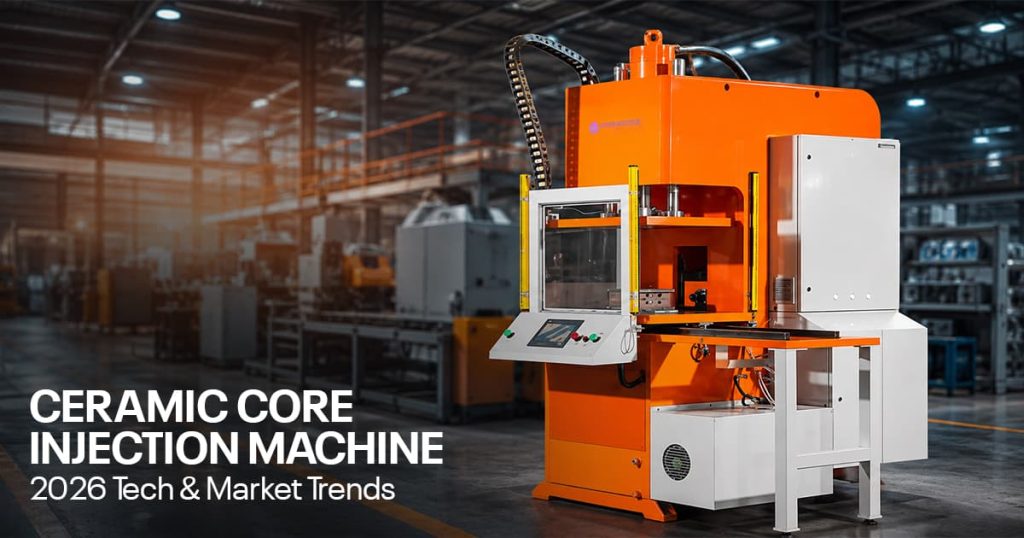
At Laxminarayan Technologies we build, install, and service the ceramic core injection machine almost every working day, so we know how much this one unit decides the quality of a finished casting. A ceramic core injection machine shapes the internal ceramic cores that give hollow form to turbine blades, vanes, and other precision parts. In this 2026 guide we explain what the machine does, how it runs on a real shop floor, the newest technology worth your money this year, and where global demand is heading.
What Is a Ceramic Core Injection Machine?
A ceramic core injection machine is a precision unit that pushes a heated ceramic paste into a metal die under controlled pressure. The paste is a blend of fine ceramic powder, usually silica, alumina, or zircon, mixed with a wax or polymer binder. Once the paste fills the die and sets, the die opens and releases a solid ceramic core.
That core later sits inside a wax pattern during investment casting, so the poured metal forms an exact internal cavity once the core is removed. This is the heart of ceramic core making for hollow parts. Foundries in aerospace, power generation, automotive, and medical casting all rely on a steady ceramic core injection machine to hit tight tolerances batch after batch.
How a Ceramic Core Injection Machine Works
On our floor the process runs in five clear steps.
-
Paste preparation. We heat the ceramic and binder mix to a soft, flowable state and hold it at a steady temperature.
-
Injection. The machine injects the paste into a closed die at a set pressure and speed. Steady control here decides core density and surface finish.
-
Holding and cooling. Pressure stays on while the paste cools, which stops shrinkage voids and keeps the core straight.
-
Ejection. The die opens and the green core is removed by hand or by ejector pins.
-
Firing. The green core is later fired in a kiln so it gains the strength it needs for the next stage.
Once fired, the core joins the wax pattern and moves into the shellroom, where supporting equipment such as a slurry transfer pump keeps the coating process smooth. A good ceramic core injection machine keeps every one of these steps repeatable, which is why cycle-to-cycle consistency matters far more than raw speed.
Key Benefits You Can Measure
A well set up ceramic core injection machine gives a foundry results you can put on paper:
-
Lower reject rate. Stable pressure and temperature control commonly bring core rejects down to the low single digits in percent.
-
Tight dimensions. Cores hold fine tolerances, so finished parts need less rework.
-
Better material yield. Precise dosing means less wasted paste and fewer scrapped cores.
-
Energy savings. Modern heaters and servo drives cut power use compared with older hydraulic units.
-
Faster changeovers. Recipe storage lets an operator switch parts in minutes, not hours.
For any shop doing serious ceramic core making, these gains add up quickly across a full production year.
Latest 2026 Technology in Ceramic Core Injection
The 2026 machines on the market show a clear shift toward tighter control and cleaner operation.
-
Servo driven injection. Electric servo units replace older hydraulics, giving smoother pressure curves and quieter, cleaner running.
-
Closed loop pressure and temperature control. Sensors track the paste through the full shot and correct drift as it happens, so the tenth core matches the first.
-
Recipe and shot data logging. Each job stores its own settings, and full shot records help trace any defect back to its cause.
-
Better die heating. Zoned heaters hold even temperature across large dies, which matters for long aerospace cores.
-
Safer, greener design. Lower binder fumes, better guarding, and reduced power draw fit the 2026 push for cleaner foundries.
We see the same shift toward servo control and data logging in wax injection machine technology, which pairs closely with core making. At Laxminarayan Technologies we fit these upgrades to both new builds and older machines, so a working ceramic core injection machine can be modernised without a full replacement.
2026 Market Trends and Global Demand
Demand for the ceramic core injection machine in 2026 is strongest wherever precision casting is growing. India is expanding fast as local foundries take on more aerospace and turbine work at home instead of importing cores. The United States remains a large market, driven by aerospace groups such as Howmet Aerospace that need a steady core supply chain. In the United Kingdom, engine makers like Rolls-Royce keep core demand high for their suppliers. Germany, home to MTU Aero Engines, and China both continue to invest in new casting capacity.
Across these countries the trend is the same: buyers want machines that cut rejects, save energy, and record every shot. Industry bodies such as the Investment Casting Institute point to the same demand for repeatable, data backed core production that we hear from our own customers.
How to Choose the Right Machine
When you compare an investment casting core machine, look past the sticker price. Check the injection pressure range, the die size it can hold, the quality of temperature control, and how easy it is to store and recall recipes. Ask about spare parts lead time and local service, because downtime costs far more than the machine itself. A ceramic core injection machine is a long term asset, so buy for the parts you plan to run in five years, not only for today.
Frequently Asked Questions
Question: What is a ceramic core injection machine used for?
Ans: It forms ceramic cores that create hollow internal spaces in metal castings, most often turbine blades and vanes made through investment casting.
Question: What materials go into ceramic core making?
Ans: A typical mix uses fine silica, alumina, or zircon powder with a wax or polymer binder. The exact recipe depends on the part and the firing schedule.
Question: How long is one injection cycle?
Ans: Cycle time depends on core size, but many small and medium cores run in one to three minutes per shot, including holding and cooling.
Question: Can an older machine be upgraded?
Ans: Yes. Many older units can take servo drives, new controls, and shot data logging, which is often far cheaper than buying a full new ceramic core injection machine.
Question: How do I keep the machine running well?
Ans: Follow a simple routine: clean the nozzle and die, check the heater zones, service the drive, and keep the paste recipe consistent from batch to batch.
About the author
This guide was written by the engineering team at Laxminarayan Technologies, a maker of investment casting equipment including the ceramic core injection machine, wax injection machine, and steam dewax autoclave. We build, install, and service this equipment for foundries every day. For full specifications, visit our ceramic core injection machine product page With contact us on +91 9422417760