
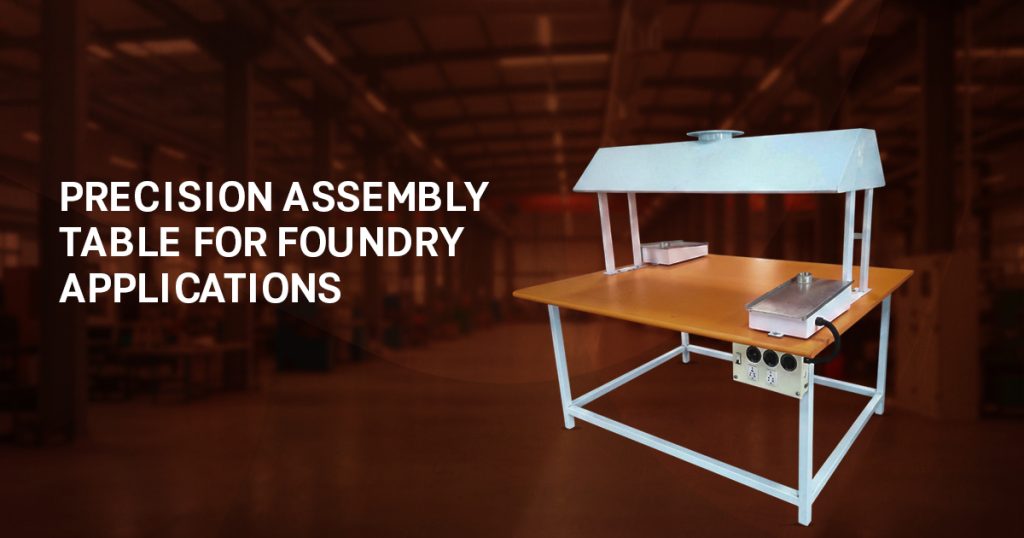
The investment casting business is all about having a great process rather than relying on specific machines to get precision and efficiency. Each individual work station must promote quality and comfort to the operators. The assembly table is one of the more important, yet often overlooked, workstations. The assembly table is used in almost all the work steps: wax assembly, cluster assembly, inspection, and handling. The assembly tables help in all three categories of keeping them on a positive level – the tables help in maintaining dimensional accuracy, reducing defects, and boosting productivity. This blog aims to provide knowledge about Assembly Tables in investment casting, focusing on the concepts, working importance, design features, applications, and benefits, as well as the solutions provided by Laxminarayan Technologies.
How Assembly Fits Into Investment Casting
One by one, once the wax parts come out of molds, workers attach them around a main stem. That setup – called building a wax tree – shapes how molten metal moves later on. If connections wobble or tilt, gaps may appear in the finished piece. Weak links here often mean thin spots in coating or warped shapes down the line. How pieces sit together decides whether cooling happens evenly across the batch.
The assembly operation typically involves:
-
Positioning wax patterns accurately
-
Welding or bonding patterns to the sprue
-
Ensuring correct angles and spacing
-
Inspecting joints and dimensions
-
Preparing the assembly for shell building
What An Assembly Table Is?
A workspace built for putting together wax patterns stands ready in today’s foundry setups. Its top stays steady and level, made to handle precise tasks without shifting. Some let you change how high they sit, others spin slowly into position. Clamps hold pieces firmly while tools reach every angle needed. These aren’t just workbenches any more – they act like part of the machinery itself.
Fine-tuned for investment casting, Laxminarayan Technologies assembly tables stand up to tough conditions while staying easy to adjust. Their design puts worker comfort first without sacrificing strength. Built to last, they move smoothly between tasks. Each detail supports steady performance under pressure. Tough materials handle daily wear without slowing down.
Design Elements of Laxminarayan Technologies Assembly Tables
Rigid and Stable Build
When precision matters, solid construction makes a difference. These workbenches rely on rugged frames to stop vibrations dead. Without steady support, tasks like joining wax parts or setting angles risk going off track. Tiny shifts add up – accuracy slips fast if the base wobbles.
Taller Settings Help Comfort
Sitting too low or standing too high wears you out faster. When the table moves up or down, your body stays balanced without extra effort. That balance means fewer mistakes over time. A setup that fits you cuts down on sore wrists or shoulders after hours of motion.
Adjustable Work Area
Fine work often needs viewing from different sides. A swiveling platform helps shift wax setups gently into place – less touching means fewer breakages.
Tool and accessory integration
Built-in spots for wax tools, lights, or clamps often show up on assembly tables. Less reaching around happens when everything has its place. Efficiency climbs simply by cutting down unnecessary motion.
Heat Resistant Easy Clean Surface
A spark here melts just enough wax to bond parts. These worktables wear skins that laugh at heat, shrug off goo. Clean-up slides right along without sticking.
Using a dedicated assembly table
1. Improved Assembly Accuracy
Built on a flat table, alignment of wax forms stays exact. Because of that, the group holds steady when poured. Flow inside follows smooth paths, thanks to even layout underneath.
2. Enhanced Operator Productivity
Movement becomes smoother when tools fit right into the workflow. Because of that, fewer steps stand between tasks. Workers put together more units each day without losing accuracy. What matters most shows up in steady results over hours.
3. Less wax damage fewer corrections
A sudden jolt can ruin a wax pattern. Smooth moves prevent breaks. Careful holds stop cracks from forming. Missteps lead to wasted pieces. Steady hands avoid extra work later.
4. Better Process Standardization
Finding consistency easier? That happens when every team uses identical setup guides at casting stations. Shift changes bring fewer surprises that way. Workers follow the same steps, no matter who’s on duty. Uniform methods start looking normal after a while. Quality checks become less stressful under such routines.
5. Improved Workplace Safety
Sitting right helps. Light that works well matters too. Tools kept neat make a difference. Fatigue slips away when setup supports movement. Injury drops if the space fits the task.
Applications in Investment Casting Foundries
Assembly tables are used across multiple stages of foundry operations, including:
-
Wax pattern assembly and clustering
-
Sprue and runner attachment
-
Wax repair and rework
-
Dimensional inspection of wax trees
-
Preparation for shell building
They are suitable for foundries producing components for:
-
Aerospace and defense
-
Automotive
-
Industrial machinery
-
Power generation
-
Medical and precision industries
Integration with Laxminarayan Technologieswax and shell building equipment
Tables built by Laxminarayan Technologies fit neatly between earlier and later machinery in your line. One piece links smoothly right after another. Equipment on both sides connects without fuss. Each setup works well with what comes before it. Later stages also match up easily. These tables help keep things moving steadily along.
-
Wax injection machines
-
Wax welders
-
Robotic and manual shell building systems
-
Wet blends stirred here. Tanks where tools go under come next
Few things help as much as getting materials moving without delays inside a foundry. Layout gains speed when steps link well.
Economic Impact of Well Designed Assembly Stations
Even though assembly tables aren’t high-tech like robotic systems, they still shape costs in big ways. Better precision during buildup means fewer errors later on, which cuts waste and boosts output quality across production lines.
A solid workbench speeds things up when the process flows well. That setup also trims expenses over time. Efficiency gains come from how parts move, not just the surface they sit on.
Future Trends in Assembly Workstations
As investment casting foundries continue to advance in automation and standardization, the design of assembly tables will continue to change. Future enhancements may consist of:
-
Permitting increased automation, motorized height/rotation, and added control
-
Digital aids for measurement and alignment
-
Modular adaptations for various casting families
-
Integration with production tracking systems
Laxminarayan Technologies will continue to evolve assembly table solutions that will meet current foundry standards, including ergonomics.
Conclusion
The Assembly Station is a base element of good wax assembly and cluster preparation in investment casting. It provides stability, ergonomic support, and process organization which in turn enables foundries to see improved quality, greater productivity, and better safety.Laxminarayan Technologies’ assembly tables we have designed with the foundry environment in mind robust build, practical features, and easy integration with casting processes. For foundries that are into precision, efficiency and long term operational success, putting in a quality assembly station is a smart and necessary step.