
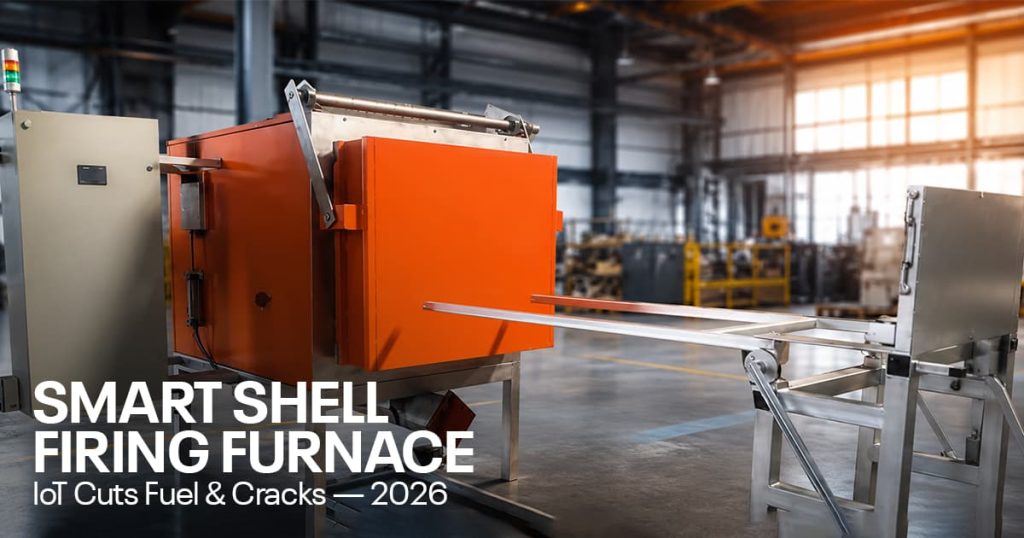
At Laxminarayan Technologies, we build investment casting equipment for foundries that cannot afford waste. Out of every machine we make, one keeps coming up in almost every client conversation: the shell firing furnace. In 2026 this furnace looks very different from the models we sold ten years ago. The biggest reason is IoT, the network of smart sensors that now watch heat, fuel, and shell quality in real time. In this post I want to share, as someone who works with these furnaces every day, how a smart shell firing furnace cuts your fuel bill and stops your shells from cracking.
What is a shell firing furnace?
A shell firing furnace heats and hardens the ceramic shell mould before molten metal is poured into it. That shell is built earlier in the line by dipping a wax pattern into ceramic slurry, layer by layer, until it is thick enough to hold hot metal. The furnace then burns out the leftover wax, drives out moisture, and sinters the ceramic so the shell stays strong. When firing is uneven, the shell develops weak spots and cracks. A cracked shell almost always means a rejected casting, wasted metal, and a late order. So the furnace is not a small part of the process. It decides how many good castings you ship each day.
Why fuel and cracks decide your profit
Two costs quietly eat into every foundry margin: the fuel burned to reach firing temperature, and the castings lost to cracked shells. Older furnaces ran on fixed burner settings, so they often overheated the chamber and burned more gas or diesel than the job actually needed. They also heated shells unevenly, which pushed up the crack rate. If you fix these two problems together, you protect both your fuel budget and your yield at the same time.
How IoT changed shell firing in 2026
A smart shell firing furnace adds sensors and a simple controller to the same proven furnace body. Here is what that means on the shop floor:
-
Real time temperature control keeps every zone at the set point, so shells fire evenly.
-
Automatic fuel adjustment matches the burner output to the real load inside the chamber.
-
Remote monitoring lets your supervisor check the furnace from a phone or a computer.
-
Batch data logging stores the full heat curve for every load, which helps during quality audits.
None of this replaces your team. It simply gives them clear numbers to work with instead of guesswork.
Real fuel savings
Because the burner now follows the real heat demand, the furnace stops wasting fuel once the shells reach temperature. Foundries that moved from fixed burner furnaces to smart control often report fuel savings of fifteen to twenty five percent on the firing stage alone. Over a full year of steady production, that saving usually pays back the extra cost of the sensors well within the first year.
Fewer cracks and higher yield
Even heating is the real secret to fewer cracks. When each zone holds its set point, the shell expands slowly and evenly, so it does not build up the stress that leads to cracks. Clients who track their reject rate closely tell us that a steady firing curve brings down shell related rejections in a clear and repeatable way. Fewer cracks mean more good castings from the same batch of wax, ceramic, and metal.
Who is using smart shell firing furnaces
Investment casting is a global trade, and so is the demand for reliable shell firing. Our furnaces run in foundries across India, the United States, Germany, Turkey, and the Gulf region, serving everything from automotive and pump parts to aerospace and decorative castings. Aerospace parts in particular often carry internal passages formed by ceramic cores, which are later dissolved out in a ceramic core leaching autoclave. If you want to understand how large the wider industry is, the Investment Casting Institute and the European Investment Casters’ Federation both publish useful data on casting standards and market trends.
What to check before you upgrade
Before you invest, walk through a short checklist. Confirm the maximum temperature you need for your alloys. Ask whether the sensor readings can be shown on the screens you already use. Check that spare thermocouples and burner parts are easy to source in your country. Finally, ask the supplier for the fuel and reject figures from a real installation, not just a brochure number. A furnace that comes with honest data is a furnace you can trust.
Frequently asked questions
Qeustion: How hot does a shell firing furnace get?
Ans: Most shells are fired between 900 and 1200 degrees Celsius, depending on the ceramic system and the alloy you plan to pour.
Qeustion Can I add IoT to an existing furnace?
Ans: In many cases yes. The sensors and controller can be fitted to a sound furnace body, so you do not always need a full replacement.
Qeustion Will smart control slow down my line?
Ans: No. It usually speeds the line up, because even firing needs fewer repeat batches and produces fewer rejects.
Qeustion How soon will I see savings?
Ans: Most foundries notice lower fuel use in the first month and a lower reject rate within the first few production cycles.
Final thoughts
A shell firing furnace has always been the quiet workhorse of an investment casting shop. Once firing is done and the metal is poured, the hardened shell is broken away with a pneumatic shell knockout machine, and the finished casting comes out. In 2026, adding IoT to that workhorse gives you two things every foundry owner wants: a smaller fuel bill and fewer cracked shells. At Laxminarayan Technologies, we believe good equipment should pay for itself, and a smart shell firing furnace does exactly that. If you are planning your next upgrade, this is the machine we would tell you to look at first.