
If you have spent any time running an investment casting operation, you know this truth: casting quality begins in the wax room. Not at the furnace. Not at the shell line. Right there, where raw wax transforms into a precisely conditioned fluid ready for pattern injection.
Yet many foundries still treat wax preparation as an afterthought. They rely on makeshift heating arrangements, inconsistent temperatures, and manual transfers that introduce air bubbles and contamination. The result? Rejected patterns, cracked shells, and money down the drain.
A purpose-built wax melting and conditioning machine eliminates these problems at the source.
What Does a Wax Melter Actually Do?
A wax melter is not just a heated container. It is an integrated system that performs three critical functions:
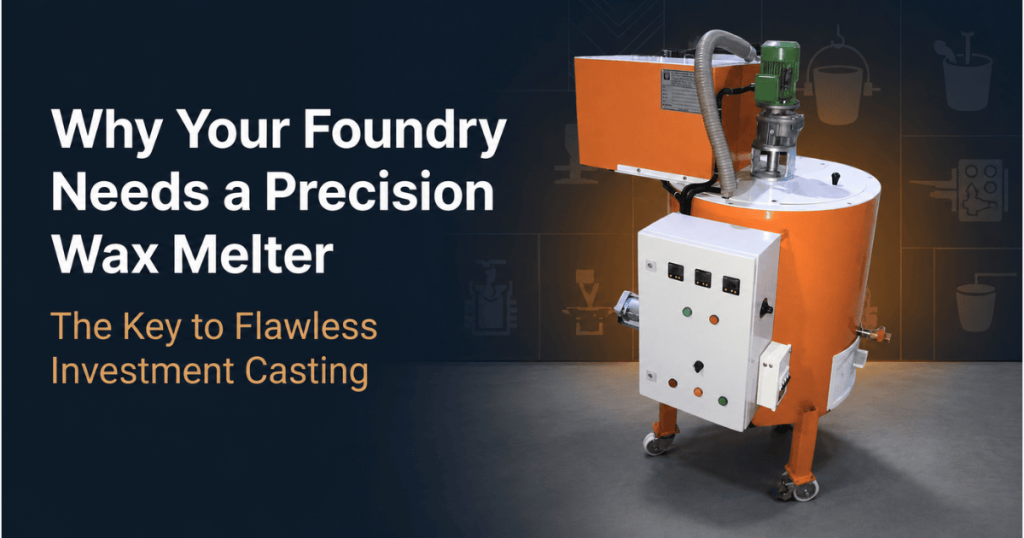
Melting: Raw wax slabs or granules are loaded into a drip melter, typically an aluminium chamber mounted above the main tank. The wax melts gradually and flows into the conditioning tank below. This drip-feed approach prevents thermal shock and overheating that degrades wax properties.
Conditioning: Inside the stainless steel conditioning tank, a motorized stirrer continuously blends the molten wax at a controlled temperature. This creates a homogeneous mixture with uniform viscosity, free from air entrapment and thermal gradients. Standard capacities range from 100 kg to 250 kg, with custom sizes available for high-volume operations.
Transfer: A temperature-controlled positive displacement pump moves conditioned wax through a heated hose directly to injection stations. This closed-loop transfer maintains wax quality from tank to die, eliminating the contamination risks of manual ladling.
How Wax Quality Impacts Your Final Castings
Research consistently shows that 20% to 70% of investment casting defects originate from wax pattern imperfections. When wax temperature fluctuates even by a few degrees, you get:
-
Dimensional inaccuracies in patterns that compound through every downstream step
-
Surface defects that transfer directly to the ceramic shell and final metal part
-
Inconsistent shrinkage rates that make tight-tolerance work impossible
-
Air pockets trapped in the wax that create shell weakness during dewaxing
A conditioning tank with continuous stirring holds temperature within a tight band, typically plus or minus one degree Celsius. That level of control translates directly into pattern consistency and lower rejection rates.
Key Features That Matter in a Wax Melting Machine
Drip Melting vs. Direct Heating
Direct immersion heating can overheat wax at contact points, altering its molecular structure and flow characteristics. Drip melting at controlled rates (10 to 15 kg per hour) preserves wax integrity while maintaining steady supply to the conditioning tank.
Mobile Design with Industrial Casters
Foundry layouts evolve. A wax melter on heavy-duty wheels can be repositioned between injection stations, shared across production lines, or moved for maintenance without crane assistance.
Integrated Wax Transfer Pump
Separate pumping systems mean exposed wax, temperature drops during transfer, and additional equipment to maintain. An integrated positive displacement pump with heated hose (flow rates up to 10 litres per minute) keeps the entire wax path temperature-controlled from tank to nozzle.
Modular Configuration
Not every foundry needs every component on day one. The ability to order a conditioning tank alone, then add the drip melter, pump, or mobility package as production grows, protects your capital investment while allowing scalability.
The Real Cost of Skipping Proper Wax Conditioning
Foundries that condition wax manually often accept a 5% to 12% pattern rejection rate as normal. With a precision conditioning system, that figure drops below 2% in most operations. On a production run of 10,000 patterns per month, that difference represents hundreds of saved labour hours, kilograms of reclaimed wax, and eliminated rework cycles.
Factor in the energy savings from maintaining wax at optimal injection temperature (rather than reheating cooled wax repeatedly), and the payback period for a quality wax melter typically falls under 12 months.
Choosing the Right Wax Melter for Your Operation
Match tank capacity to your daily wax consumption with roughly 20% headroom. A 200 kg conditioning tank suits most mid-volume foundries producing automotive, valve, or pump components. High-volume aerospace operations running multiple injection stations may require 250 kg or custom-sized units.
Consider your wax types as well. Foundries working with filled waxes or blended formulations benefit most from continuous stirring, as these materials separate quickly without agitation.
Conclusion
Precision investment casting demands precision at every stage. The wax melter sits at the very beginning of your process chain, and its performance cascades through every operation that follows. Investing in a properly engineered wax melting and conditioning system is not an upgrade; it is the foundation that makes everything else work.
Look for manufacturers with ISO 9001 certification.